Key takeaways
- The real job of a lead generation agency for cleaning companies is getting your message to the person who actually controls the budget, not just generating replies that go nowhere.
- In a recent 21-day window across Up Arrow's commercial cleaning, janitorial, pressure-washing, and carpet-cleaning client campaigns, cold email produced 69 genuine high-intent replies — 65% were forwards straight to a decision-maker.
- A pricing question isn't a brush-off; in this data set 13 of 69 replies (19%) asked for a quote, and the right next move is a walkthrough, not a blind number.
- Vet any agency on how they handle the moment after the reply: do they chase a site visit and build trust, or do they just quote and hope?
- Published Up Arrow campaign results — from a $38K/year recurring contract to $160K in closed commercial cleaning work — show that walkthrough-first follow-through is what turns replies into revenue.
The right lead generation agency for cleaning companies isn't the one that promises the biggest list — it's the one that gets your name in front of the property manager, facilities director, or office manager who actually signs vendor contracts, and then helps you turn that first reply into a signed deal. Look for decision-maker-level targeting, a process built around booking walkthroughs instead of firing off blind quotes, proof of closed commercial contracts, and a performance-based structure that puts the agency's incentives next to yours. List size and email volume are secondary. What happens after someone replies is where the hire either pays for itself or doesn't.
What a Lead Generation Agency for Cleaning Companies Actually Sells You
Most pitches from lead gen vendors sound the same: build a list, send emails, forward you the replies. That's the mechanic. What you're actually paying for is access to decision-makers who control commercial cleaning, janitorial, pressure-washing, or carpet and upholstery budgets and don't currently know your company exists. Up Arrow runs this specifically for home-service companies in cleaning verticals, entirely through cold email, without paid ads, cold calling, or door-knocking, and the work is performance-based. For a fuller breakdown of how that pipeline works end to end, our guide to commercial cleaning lead generation covers the mechanics in more depth.
The part most pitches gloss over is what a good reply actually looks like, and what to do with it. That's also what separates agencies that understand this sale from ones that are just running a mail merge.
The Part Everyone Skips: What Happens After the Reply
Any vendor can tell you how many replies a campaign generated. Few will show you what those replies actually look like, and that breakdown tells you whether an agency understands how commercial cleaning contracts actually get won. Over a recent 21-day stretch across Up Arrow's commercial cleaning, janitorial, pressure-washing, and carpet-and-upholstery client campaigns, cold email produced 69 genuine, high-intent inbound replies. Here is exactly how they broke down.
| Reply Type | Count | Share of Replies |
|---|---|---|
| Forwarded to decision-maker | 45 | 65% |
| Asked for pricing / a quote | 13 | 19% |
| Positive inbound reply | 5 | 7% |
| Offered a call / availability | 4 | 6% |
| Requested a walkthrough | 1 | 1% |
| Asked for more details | 1 | 1% |
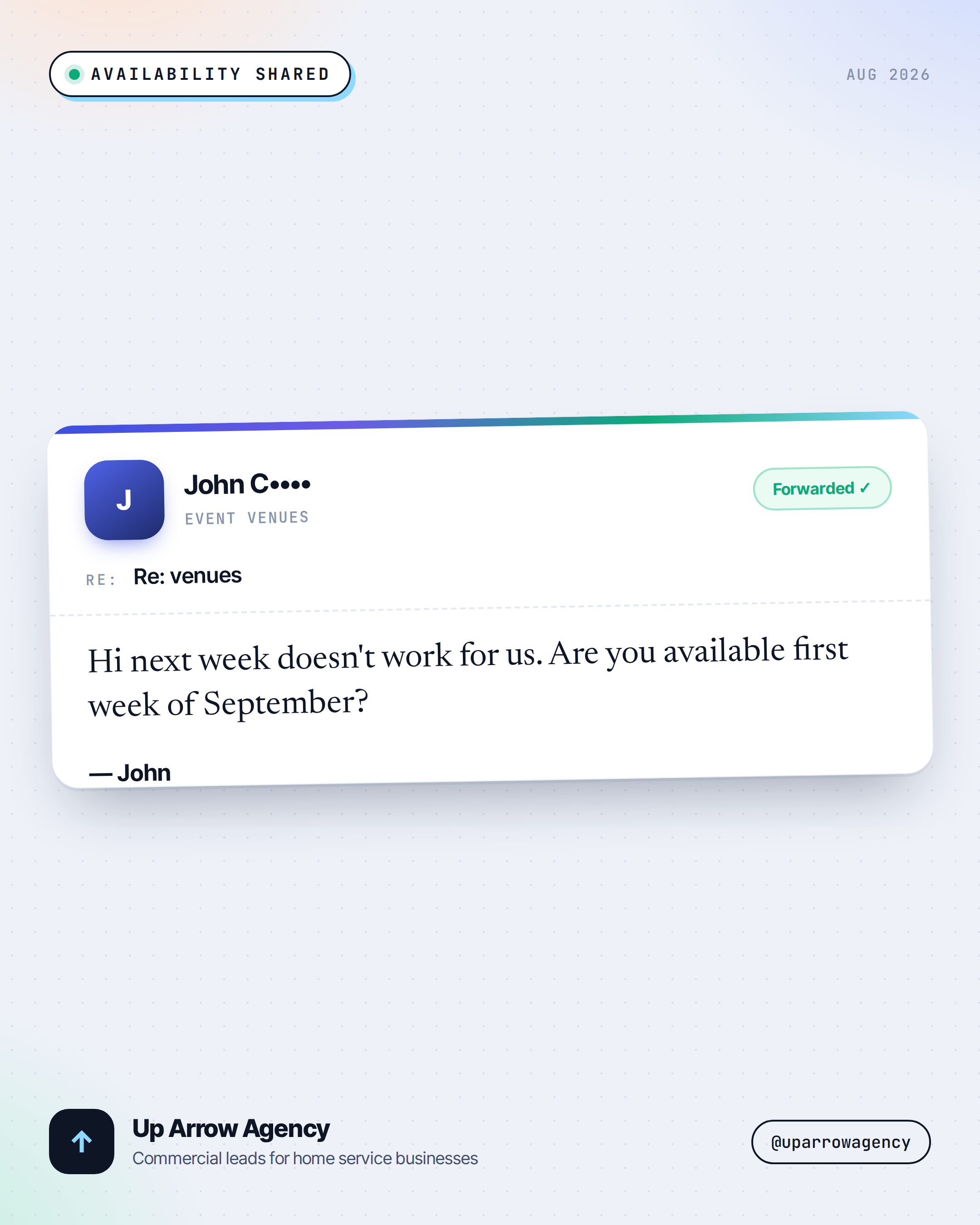
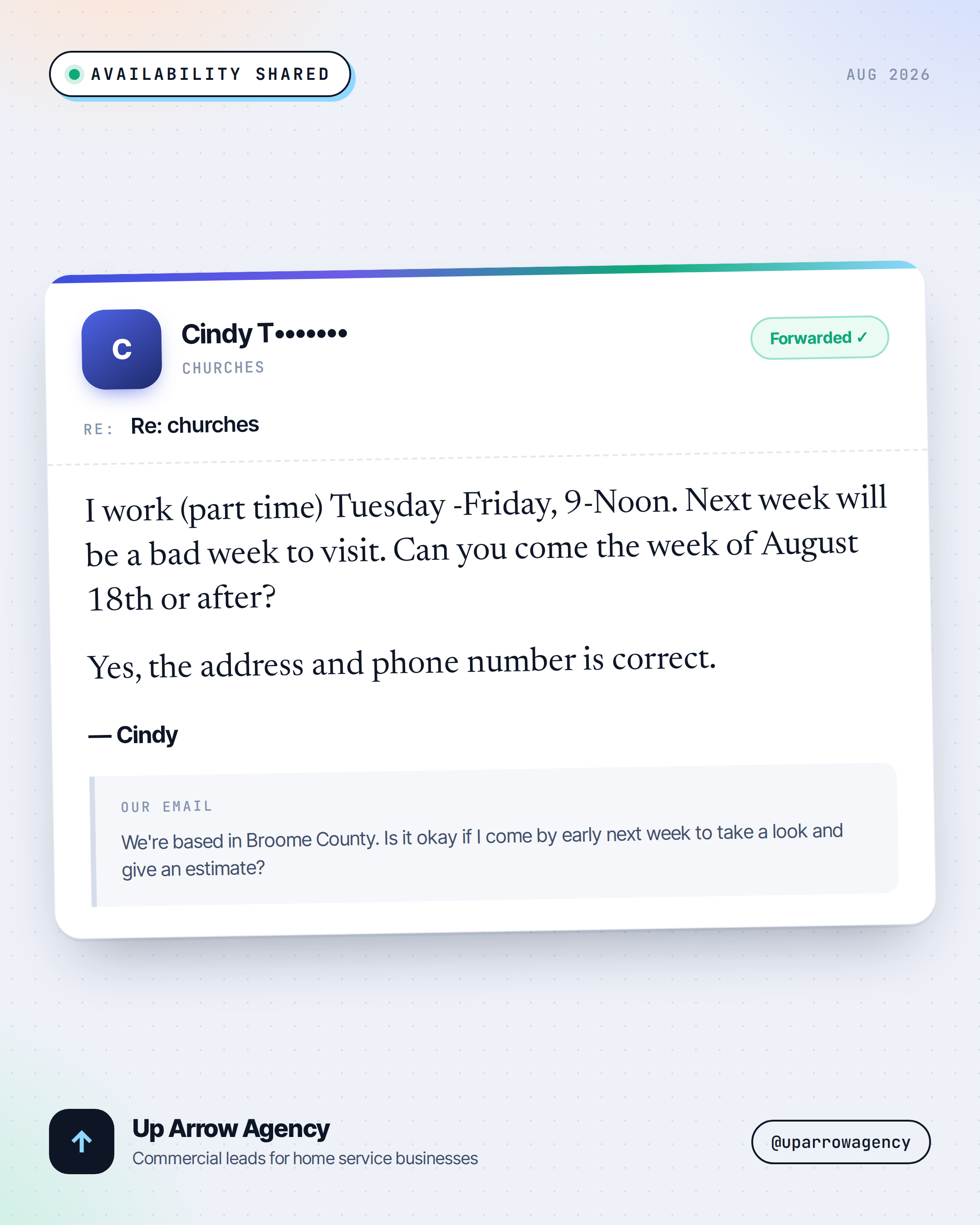
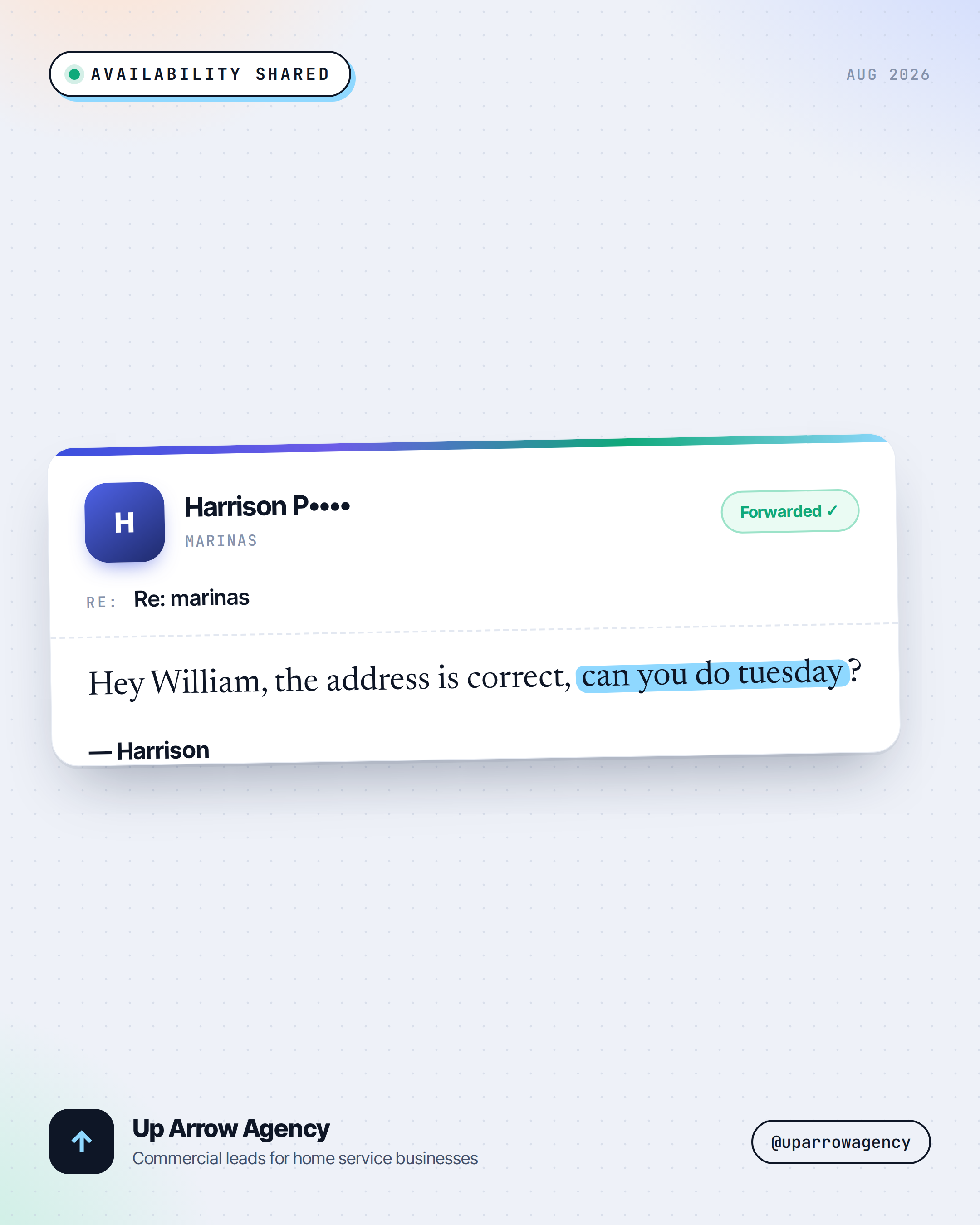
Read that table the wrong way and you'll draw the wrong conclusion. Forty-five forwards could look like gatekeepers blocking direct access — that's the wrong read. A forward is someone handing your message to the person who actually controls the budget, which is the outcome you want. Thirteen pricing questions could look like proof that buyers only care about cost — also the wrong read. Asking "how much?" is usually the easiest, lowest-risk question a facilities manager can ask a vendor they've never worked with. It isn't a verdict on price sensitivity. It's an opening.
The agency's job, and yours if you're running this in-house, is to treat a forward and a pricing question the same way: as an invitation into the next step, which is a walkthrough or site visit, not a quote fired back over email with no context.
Only one of the 69 replies in this window explicitly asked for a walkthrough. That isn't evidence walkthroughs don't matter. It's evidence that almost nobody asks for one outright. Commercial buyers rarely open with "come look at my building." They ask about price, or they forward you along, and the agencies and operators who actually win contracts are the ones who turn that price question or that forward into a walkthrough anyway, because that's where trust gets built and the deal gets decided. ISSA's own guidance on bidding for commercial cleaning contracts lists a site visit as the first concrete step in putting together a winning bid, not a courtesy step. Skip it and you're guessing at square footage and scope. Show up and you're building the relationship that gets you the contract, which matters more in a trust-based sale than in almost any other kind of selling.
What to Actually Look For in a Lead Generation Agency for Cleaning Companies
Decision-maker targeting, not a generic list
A list of "cleaning company leads" scraped from a directory is worthless if it's full of front-desk inboxes and general contact forms. Ask exactly who the agency targets, by title, and how they confirm that person actually controls vendor decisions for the property or portfolio in question. For commercial cleaning, janitorial, and pressure-washing work, that's usually a property manager, facilities manager, or operations manager, not a receptionist.
A process that routes toward a walkthrough, not a blind quote
Ask the agency directly: what happens when a prospect asks for a price before you've met them? If the answer is "we send a number," that's a red flag. The right answer is some version of "we get a walkthrough on the calendar first." Facilities managers buy from vendors they've met and trust, and a walkthrough is where you scope the job accurately, demonstrate competence, and take the risk off their plate before anyone talks price. Formal guidance from facility management's own trade body backs this up: IFMA's Knowledge Library frames supplier vetting as something that depends on real evaluation and relationship-building, noting that "only thorough screening, excellent communication, training, and trust can develop a supplier/client relationship." An agency that skips straight to pricing is working against how these buyers actually decide.
Performance-based pricing
If an agency is confident in its own targeting and process, it should be willing to tie its fee to results rather than asking you to pay flat for activity alone. This also tells you something about incentive alignment: a performance-based vendor only gets paid when the system is actually producing qualified conversations, not just sent emails.
Proof of closed commercial contracts, not just "leads delivered"
Leads are a leading indicator. Contracts are the number that pays your payroll. Ask for examples of campaigns that turned into signed work, in the same vertical you operate in if possible. Across Up Arrow's own client campaigns, that follow-through is what turns a reply into revenue: one janitorial client went from 4 to 27 commercial leads in 30 days, a pressure-washing client closed a $38,000-a-year recurring contract from a single campaign, and a commercial cleaning client closed $160,000 in jobs sourced entirely from cold email. A carpet-cleaning campaign produced $23,000 in jobs on its own. None of that happened because software sent a price on request. It happened because someone treated the reply as the start of a relationship, not the end of a transaction.
A follow-through plan after the first reply
The best targeting in the world is wasted if nobody follows up fast, routes the reply to the right person on your team, and gets a walkthrough scheduled within days. Ask what the agency's process looks like between "prospect replies" and "walkthrough is on the calendar." If they can't describe that step clearly, the leads they generate will sit and go cold regardless of how good the targeting was. Our guide to getting commercial cleaning contracts walks through what to do with a qualified reply once it lands.
Red flags worth walking away from
Be wary of any agency that pitches itself on being the cheapest option, that talks about cold email purely as a volume game, or that can't explain how it handles a pricing question without quoting blind. Those are symptoms of an agency optimizing for activity metrics instead of signed contracts. Also be cautious of vendors who can't show vertical-specific proof — janitorial, pressure washing, and carpet and upholstery cleaning all sell slightly differently, and an agency that's only run restaurant or retail campaigns may not understand how facilities managers specifically evaluate cleaning vendors.
Frequently asked questions
How much does a lead generation agency for cleaning companies typically cost?
What's the difference between cold email lead generation and paid ads for cleaning companies?
Should a lead generation agency send a price quote as soon as a prospect asks?
How long does it take to see results from a cold email lead generation campaign for a cleaning business?
Want these replies landing in your inbox?
We run the whole cold-email engine for commercial cleaning & pressure washing companies — targeting, inboxes, and booking — so you get decision-maker conversations without ads or cold calling.
Book a 30-minute callMore from the guides: How to get commercial cleaning contracts · Lead generation: DIY vs. done-for-you · All guides