
Key takeaways
- A commercial cleaning quote request is a buying signal. The buyer has engaged and is asking the easiest question available, not announcing that price is all they care about.
- A number sent without context lands next to every other number in their inbox. A walkthrough is where the scope, the risk and the trust get built.
- Accurate commercial cleaning pricing depends on building type, frequency and scope, which is why industry guidance itself recommends seeing the site first.
- Of 958 prospects who asked about price in our clients' replies (April to October 2026), 222 offered a call or a specific time and 184 asked for a walkthrough or site visit.
- The play that converts: acknowledge the question, explain what drives the number, and offer a short, free walkthrough to give them a real one.
A commercial cleaning quote request almost always means the prospect is interested and doesn't yet have enough information to say so any other way. "What would this cost?" is the simplest question a busy facilities or property manager can ask. It tells you they read your message, they have a building, and they're willing to start a conversation. It does not tell you they'll pick the cheapest bid.
That distinction matters, because how you read the request decides what you send back. Read it as a price check and you fire off a number. Read it as a buying signal and you start building the case for why you're the one to walk the building.
What a commercial cleaning quote request actually signals
Think about the position the manager is in. They've got a facility, maybe several, an incumbent vendor who is either fine or quietly failing, and a stack of other things to do before lunch. A new vendor shows up. They know almost nothing about you. They have no way to judge your crews, your supervision, or how you handle a missed service. The one thing they can ask about without any context is cost.
So the request is real interest wearing the most convenient clothes. Early in a relationship, price is a stand-in for "help me understand what I'd be getting." Buyers fixate on the number mostly when nothing else has been put in front of them yet.
That lines up with what procurement guidance says when you read it closely. ISSA's breakdown of the government RFP process for cleaning vendors notes that proposals are scored on technical capability, experience and past performance alongside price, and that the lowest price doesn't always win. That article covers public-sector bids, so don't stretch it too far. But the logic carries: even formal buyers are told to look for best value.
Why a blind number hurts you
If you reply with a figure and nothing else, three things tend to happen.
First, you've anchored the whole relationship on price, which is the one dimension where you can't prove you're better. Second, your number is built on guesses about square footage, traffic, floor types, restroom counts and frequency, so it's either padded or too thin. Third, you've handed the manager a document to forward around and compare, with none of the context that would make your offer different from the next one.
The pricing itself isn't a mystery, but it is site-specific. ISSA's own guide to commercial cleaning rates per square foot says rates vary with building type, service frequency and the scope of what's included, and it recommends a site walkthrough so estimates rest on real measurements and firsthand evaluation. A veteran trade-publication piece on janitorial bidding and estimating goes further and warns against trusting blueprints or old numbers without walking the space. The people who write the bidding advice are telling you the same thing the buyer needs: see the building first.
The reply that turns a quote request into a walkthrough
The move is simple. Treat the question as legitimate, answer the part you honestly can, and offer the walkthrough as the way to get them a number they can rely on.
Acknowledge, then explain what drives the number
Don't dodge. Tell them what moves the price in a building like theirs: square footage, the mix of carpet and hard floors, how many restrooms, how often service runs, after-hours access. That shows you know the work. It also makes it obvious why a figure sent sight unseen would be unreliable, without you having to say so.
Offer a short, free walkthrough
Ask for fifteen to thirty minutes on site. Make it easy: you come to them, you work around their schedule, there's no cost and no commitment. A manager who's lukewarm on "another cleaning vendor" will often say yes to "let me see the space so I can give you a number that holds." You've lowered their effort and their risk, and you've given them a reason that serves them.
Use the visit to build the offer
On site, you learn what's actually bothering them: a restroom complaint, a floor that never looks right, an incumbent who doesn't answer calls. That's what you build the proposal around. You also meet the person, which matters more than most vendors admit. Facilities managers hire people they've met and trust. One B2B buying study reported by PRmoment found half of senior buyers ranked trust as the deciding factor ahead of cost. It surveyed technology buyers, not cleaning buyers, and I'd treat it as directional rather than proof. Still, it matches what we see in the field.
What the replies we see look like
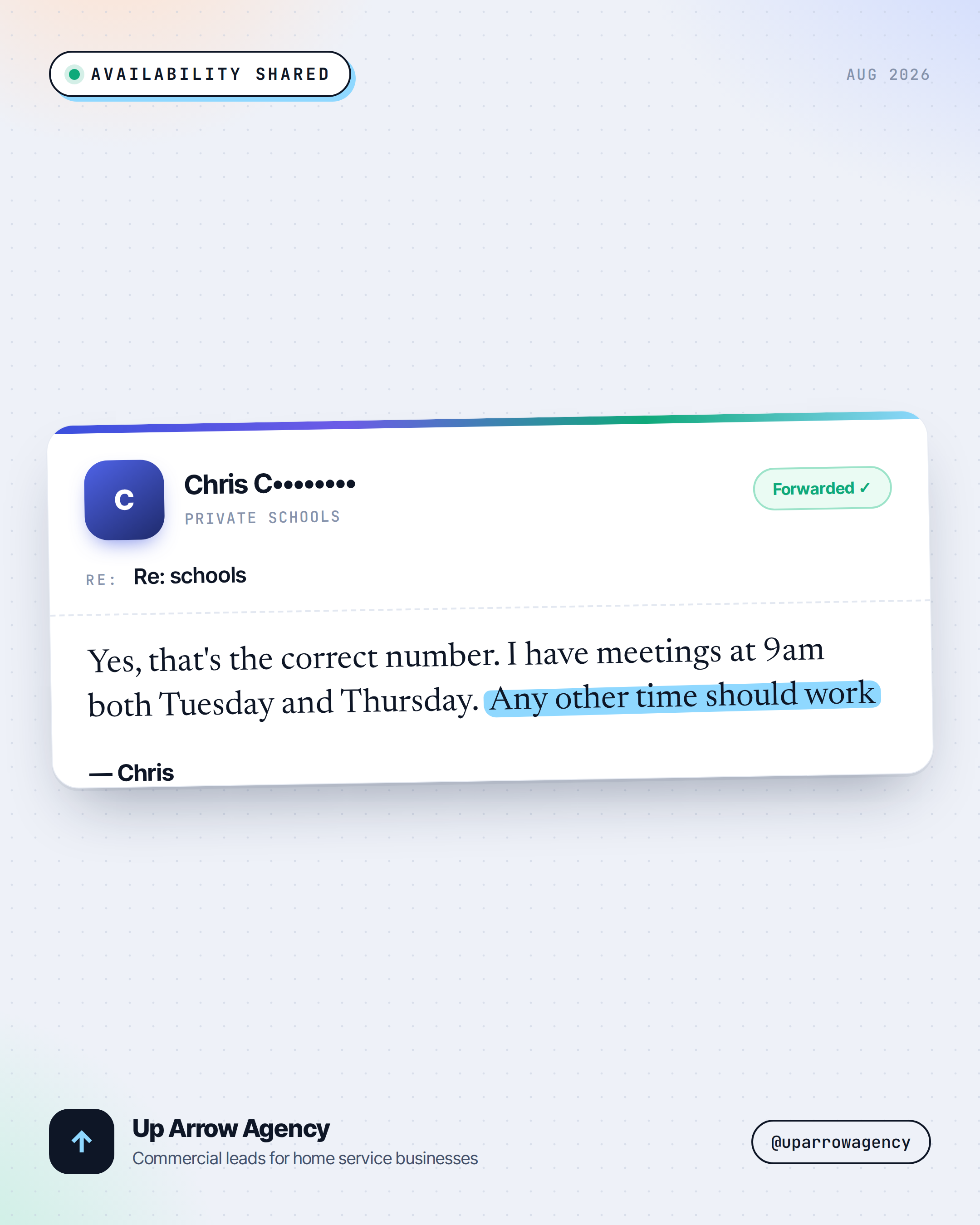
We run cold email for commercial cleaning, pressure washing and janitorial companies, so we see a lot of first replies. Across April to October 2026, 958 genuine inbound replies in our clients' campaigns were from prospects asking about pricing or a quote. Here is what else those same prospects did.
| What the price-asker also did | Replies (of 958) |
|---|---|
| Forwarded the thread to the decision-maker | 393 |
| Offered a call or a specific time to talk | 222 |
| Asked for a walkthrough or site visit | 184 |
Read that carefully. Prospects who opened with "how much?" went on to loop in the person who signs, put a time on the calendar, or ask someone to come look at the building. The price question was the first line of a longer conversation, not the whole of it. If the reply to those people is a bare number, most of that momentum goes nowhere.
A composite example
Picture a property manager at a mid-sized office portfolio, for example, who answers a cold email with one line asking for rates. A vendor who sends back a per-square-foot figure has joined a pile. A vendor who replies with two sentences on what drives cost in a building that age, then offers to walk the floors on Thursday, has made themselves the easiest person to say yes to. The manager still gets a price. They just get it from someone they've met, based on what's actually in the building.
This is the same pattern behind the results our clients have published, such as winning commercial cleaning contracts from cold outreach: $160K in commercial cleaning jobs closed from cold email, and a $38K/year recurring contract from a single campaign. Those came from replies that were moved into a room, not replies that were answered with a rate sheet.
When the quote request is a poor fit
Not every request is worth a trip. If someone wants a one-time job in a space far outside your service area, or insists on a bare number for an RFP they've already half-awarded, say so politely and quickly. Part of running a good operation is knowing where your time pays. But that's the exception. The default should be to treat a commercial cleaning quote request as an invitation.
Why speed still matters
Reply fast, but for the right reason. Speed gets you to the walkthrough while the manager still has your email open and the question fresh. It isn't a reason to skip the conversation. If you want the full system behind getting those replies to begin with, see our guides on cold email for cleaning companies and commercial cleaning lead generation.
Frequently asked questions
Should I give a price when someone sends a commercial cleaning quote request?
Does asking for a quote mean the prospect only cares about price?
What affects the cost of commercial cleaning?
How do I get a walkthrough booked from a quote request?
Want these replies landing in your inbox?
We run the whole cold-email engine for commercial cleaning & pressure washing companies — targeting, inboxes, and booking — so you get decision-maker conversations without ads or cold calling.
Book a 30-minute callMore from the guides: How to get commercial cleaning contracts · Lead generation: DIY vs. done-for-you · All guides