
Key takeaways
- Commercial window cleaning contracts are won by getting in front of the person who controls the building, then earning trust at a site walkthrough. They are not won by having the lowest number.
- The best buyers are property managers, facilities managers, and operations managers who own a recurring facility spend. Homeowners and one-off jobs are a different business.
- When a prospect asks 'how much?', treat it as a buying signal and offer a walkthrough. A blind quote turns you into a commodity.
- Height work raises the stakes. Be ready to talk about fall protection, inspection routines, training, and insurance before the buyer has to ask.
- Cold email works for this because the buyers are identifiable and the work recurs. The goal of the first email is a conversation, not a sale.
To win commercial window cleaning contracts, put your name in front of the people who own recurring facility spend (property managers, facilities managers, office and operations managers), then convert interest into an in-person walkthrough where you build trust and propose a tailored, recurring scope. The first part is outbound. The second part is where the contract is actually won. Most window cleaners get the first part wrong by chasing whoever answers the phone, and the second part wrong by emailing a number and hoping.
Who actually buys commercial window cleaning contracts
Residential window cleaning is sold to the person whose windows are dirty. Commercial work is sold to someone who is accountable for a building, a portfolio, or a budget line. That changes everything about how you approach it.
The people worth targeting:
- Property managers running office, retail, or mixed-use buildings, who handle vendor contracts on behalf of owners.
- Facilities managers at corporate offices, medical buildings, schools, and multi-site operators.
- Office and operations managers at smaller companies where nobody has a facilities title and the job lands on them.
These buyers are busy, they have a current vendor or an informal arrangement, and a missed or sloppy visit reflects on them. They are rarely shopping. They respond when the timing is right and the approach is low-effort and credible. Professional bodies like IFMA exist because facility management is a profession with its own buying habits and risk concerns, and it helps to write to that person as a colleague, not as a homeowner.
Why window cleaning is a better contract than it looks
Windows are a recurring, scheduled service. A building does not stop having glass. Once you are on the calendar (quarterly, monthly for storefronts, more often for high-visibility lobbies), the revenue repeats with very little selling. That is why a single contract can matter more than ten one-off jobs.
It also pairs naturally with other exterior and interior services. A buyer who trusts you with the glass is a short conversation away from pressure washing, janitorial, or floor care. If you are building a wider book of business, our pillar guide on how to get commercial cleaning contracts covers how those services stack.
Step 1: Get in front of decision-makers without paid ads
Referrals are great but you cannot schedule them. Cold calling burns hours on gatekeepers. Door-knocking reaches the front desk, not the manager. Cold email is the most controllable channel for this audience, because the buyers are findable by title and building type, and one email lands directly with the person who can say yes.
What works in a commercial window cleaning email:
- Write to one role and one building type. A message to multi-tenant office managers should read differently than one to a retail property manager.
- Lead with the outcome the buyer cares about (clean glass on a predictable schedule, no tenant complaints, no coordination headaches), not your equipment list.
- Ask for something small: a short conversation or a look at the property. Do not ask for a contract.
We cover the mechanics in our guide to cold email for cleaning companies. At Up Arrow Agency, this is the channel we run for our clients, and it has produced results like 12 commercial opportunities in 26 days and a $38K/year recurring cleaning contract from a single campaign. Those are cleaning-industry outcomes, not window-specific guarantees, but the mechanism is the same.
Step 2: Treat the price question as a buying signal
Here is the pattern that trips up most operators. You send a good email, someone replies, and the reply is short: what do you charge?
That is a normal first question. It is the easiest thing for a busy person to ask, and it usually means they have just enough interest to start evaluating. It does not mean price is the only thing they care about. They simply do not have enough context yet to ask anything better.
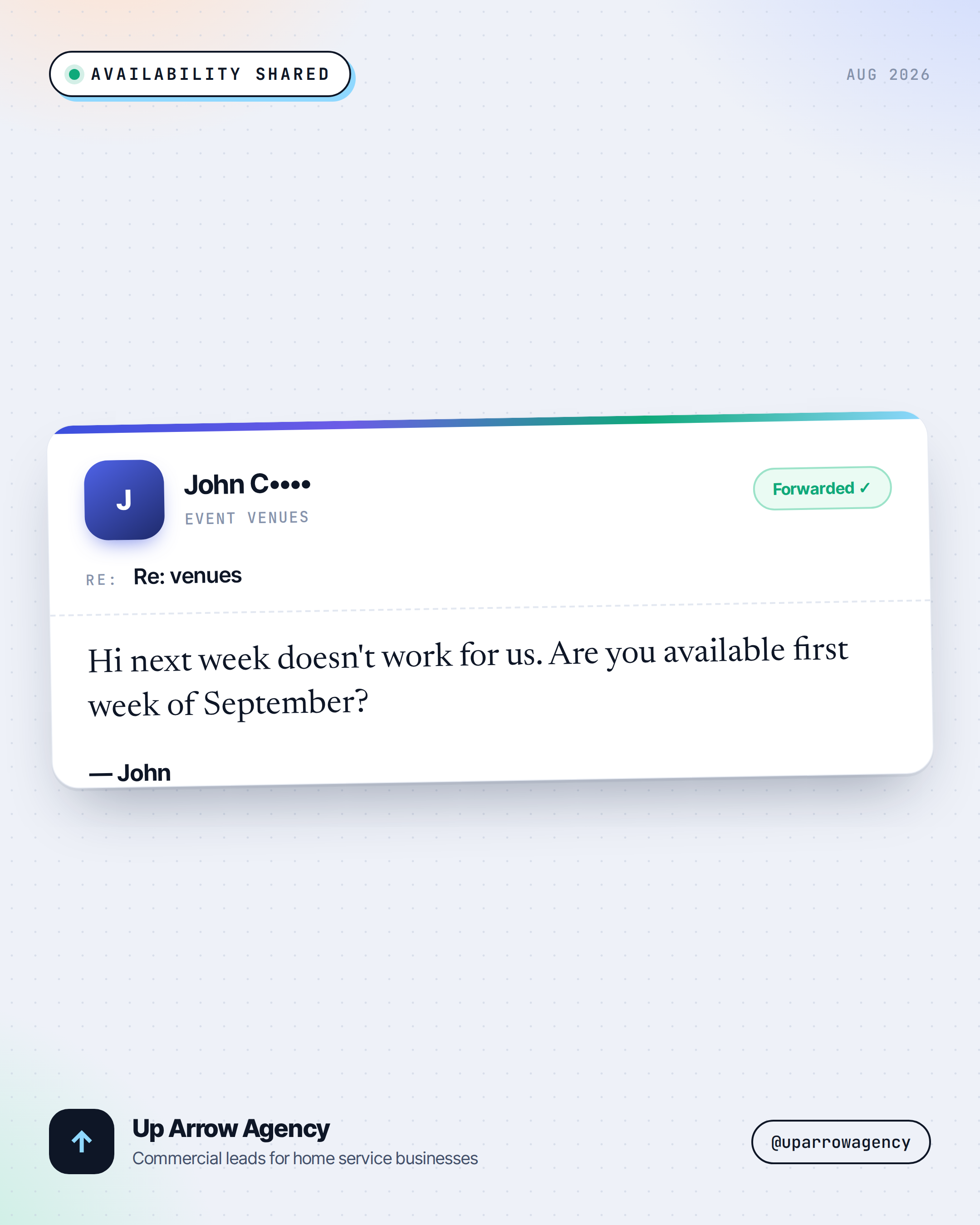
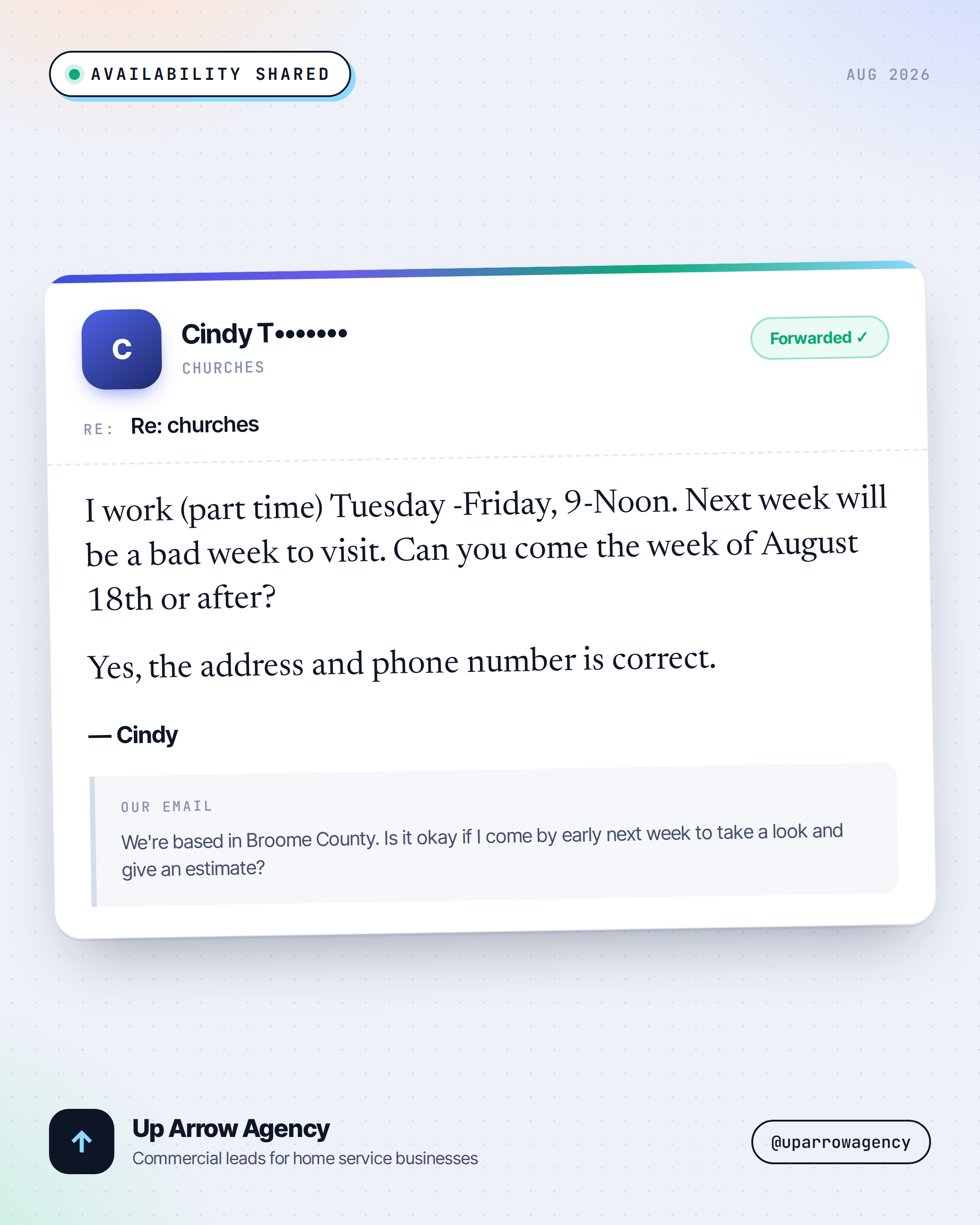
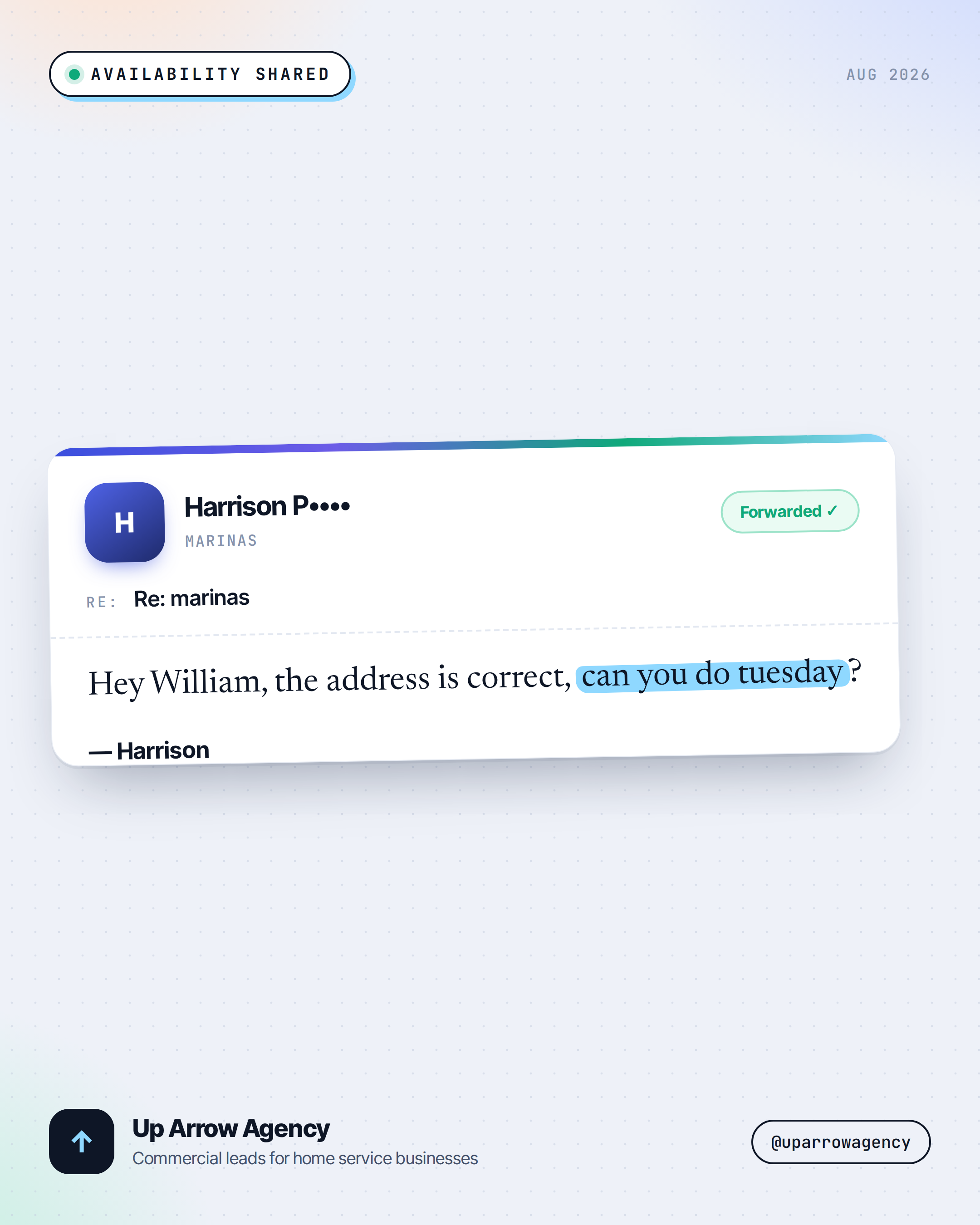
In the window cleaning replies our clients received between April and November 2026, 182 of 203 genuine replies asked about pricing or a quote. Only 15 asked outright for a walkthrough or site visit. That gap is the opportunity. The prospect has opened a door, and the vendor's job is to walk them toward the conversation that makes price one input among many instead of the only one.
A composite example: a facilities manager at a multi-site office portfolio replies asking for a ballpark. If you send a number, you have anchored the whole relationship on price, and you are now one of three quotes in a spreadsheet. If you instead say you would like to walk the property first so the quote reflects the actual glass, the access, and the schedule, you have changed what you are selling. The walkthrough is where you learn what they need, show you can deliver, and take risk off their plate.
Step 3: Run the walkthrough like a sales meeting, not a measuring visit
The walkthrough is the product. It is where a stranger becomes a vendor the manager has met.
Before you go
Ask who else is involved. In many buildings the person you email is not the final signature, and in the replies we see, a good share are forwards to someone else (58 of the 203). A forward is an invitation to meet the real decision-maker. Do not treat it as a dead end.
On site
Look at what the manager sees every day. Note the glass types, the heights, the access points, the tenant sensitivities, the lobby entrance, the places that get complaints. Ask what has gone wrong with past vendors. People tell you what they actually want when you ask about the last bad experience.
Talk about safety and risk early
Window work above ground is hazardous, and a thoughtful buyer knows it. The U.S. Occupational Safety and Health Administration's guidance on two-point suspended scaffolds describes the baseline: fall protection, pre-shift inspection by a competent person, and trained workers. The industry's own access and safety standard, ANSI/IWCA I-14.1, is not itself an OSHA rule, but OSHA's interpretation letter (an archived 2005 document, so read it as background) notes it can still be used as evidence of recognized hazards. Practically, that means a building owner has a reason to care whether you follow it.
You do not need a lecture. You need a clear answer to: how do you work at height, what is your inspection routine, how are your crews trained, and what insurance do you carry? Having those answers ready is a trust signal that a lowball competitor often cannot match. Certifications like those tied to ISSA's CIMS program speak to management systems for building service contractors generally, and can support credibility if you hold one.
Step 4: Present a tailored offer that removes risk
After the walkthrough, send a proposal that reflects what you saw. Use their language: the lobby glass, the street-facing frontage, the schedule that avoids tenant hours. Make the first step easy to say yes to. A defined trial cycle, a clear scope, and a simple recurring schedule lower the effort and the perceived risk for the buyer.
This is where the recurring contract is won. Not because you were cheapest, but because you were the vendor who showed up, understood the property, and made the decision feel safe.
Step 5: Turn one contract into a book of business
Once you are servicing a building, ask about neighbors, sister properties, and other services. Property managers often oversee several buildings and talk to peers. A well-run first site becomes the introduction to the next one. Adjacent services are also natural next steps. See our guides on pressure washing contracts and janitorial contracts if you want to extend what you offer to the same buyers.
What this looks like in practice
The sequence is simple: reach the right role, ask for a small conversation, answer a price question by offering a walkthrough, meet the real decision-maker, then present a scoped recurring offer with the risk taken off their side. Operators who do this consistently produce outcomes like 48 commercial leads in 6 weeks, or going from 4 to 27 commercial leads in 30 days. The difference is rarely the email wording alone. It is that someone follows through on the reply.
If you want that top-of-funnel handled for you, Up Arrow Agency runs done-for-you commercial lead generation through cold email for home-service companies, performance-based, with no paid ads, referrals, cold calling, or door-knocking. You take the walkthroughs and win the contracts.
Frequently asked questions
How do I find commercial window cleaning clients?
Should I send a price when a prospect asks for a quote?
What do commercial buyers want to know about window cleaning vendors?
How can Up Arrow Agency help me get commercial window cleaning contracts?
Want these replies landing in your inbox?
We run the whole cold-email engine for commercial cleaning & pressure washing companies — targeting, inboxes, and booking — so you get decision-maker conversations without ads or cold calling.
Book a 30-minute callMore from the guides: How to get commercial cleaning contracts · Lead generation: DIY vs. done-for-you · All guides