Key takeaways
- Lead gen agencies work for cleaning companies when the channel produces real inbound interest AND the follow-up process is built to convert it — not just rack up replies.
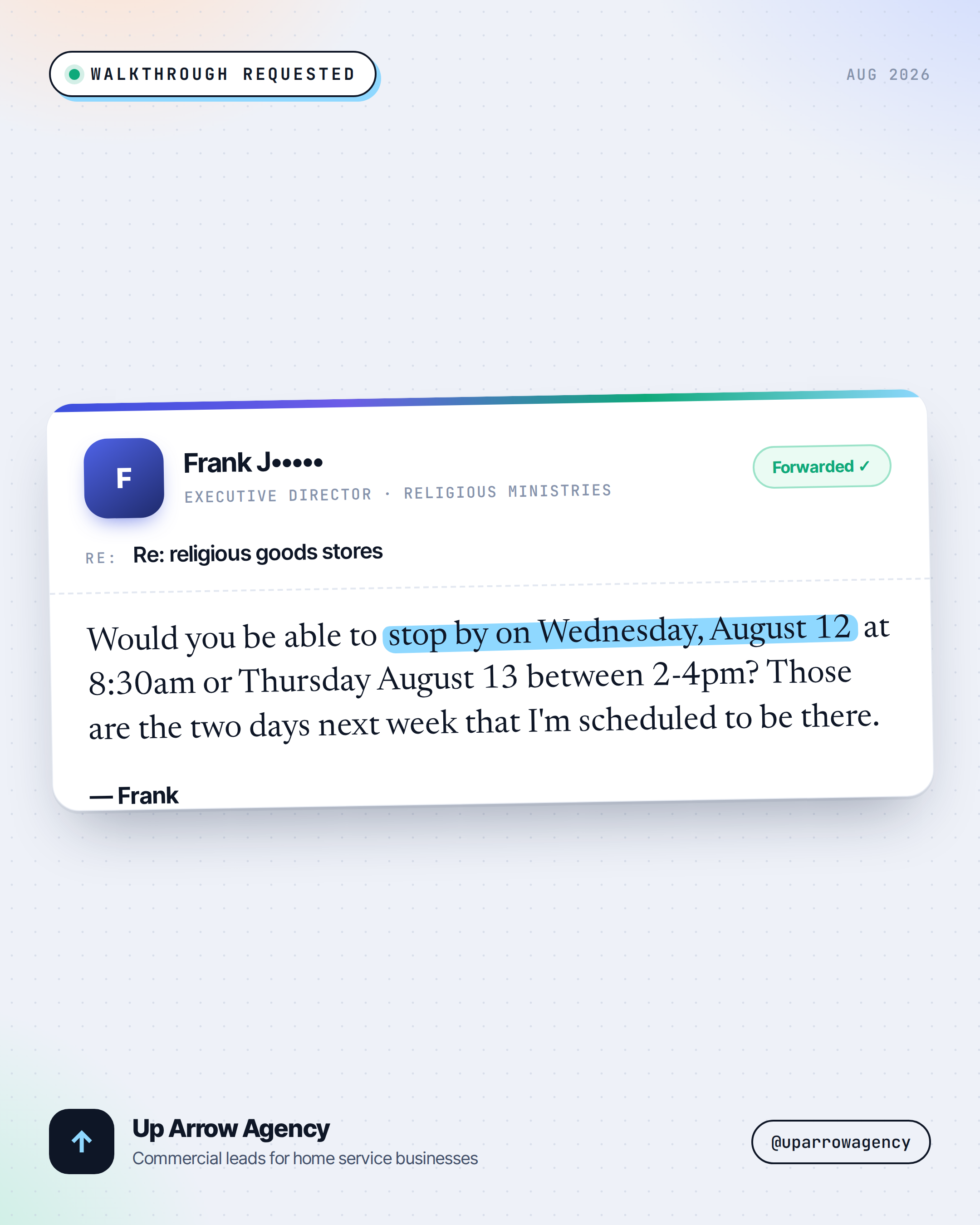
- In a 21-day sample of 69 genuine high-intent replies across carpet/upholstery, pressure washing, and commercial cleaning campaigns, 45 were forwarded straight to a decision-maker and 13 asked for pricing — both are buying signals, not rejections.
- A pricing question this early is normal, not proof someone only cares about cost — the right move is offering a free walkthrough, not firing back a number.
- Agencies fail cleaning companies most often by quoting blind instead of booking a site visit, which commoditizes the vendor before any trust gets built.
- Published client results — $160K in commercial cleaning jobs closed, a $38K/year recurring contract from one campaign, 48 leads in 6 weeks — all ran on the same reply → walkthrough → trust → contract sequence.
Do lead generation agencies work for cleaning companies? Yes — but only the kind that treats an inbound reply as the start of a relationship, not a line item to quote and move past. Cold email is efficient at putting commercial cleaning, pressure washing, and janitorial companies in front of the property managers and facilities managers who actually control vendor budgets. What decides whether that turns into revenue isn't the email. It's what happens in the hours after someone writes back. We pulled the real reply data from the last 21 days of our clients' cold email campaigns to show what that looks like, and why agencies that treat a reply as a quote request instead of an opening are the ones that underdeliver.
What "working" actually means for a lead generation agency
"Working" doesn't mean emails get opened. It means a property manager, facilities manager, or operations manager ends up in a conversation with your company, and that conversation turns into a signed job or a recurring contract. That's the only definition that matters to an owner deciding whether to put money here instead of into another truck, another crew, or another ad budget.
Across client campaigns run this way, outcomes have included 48 commercial leads in six weeks, $160,000 in commercial cleaning jobs closed from cold email, a $23,000 carpet-cleaning job from a single campaign, a jump from 4 to 27 commercial leads in 30 days, a $38,000-a-year recurring cleaning contract from one campaign, $18,000 in commercial cleaning leads from cold email, and 12 commercial opportunities in 26 days. None of those came from ad spend, cold calling, door-knocking, or referrals. They came from a mailbox and a process for handling what landed in it.
The real data: what 69 inbound replies actually look like
Case-study numbers are useful, but they hide the mechanics underneath them. So here's the unfiltered version: over a 21-day window across our clients' campaigns, we logged 69 genuine, high-intent inbound replies — people who work in or manage a building writing back because something in the email was relevant to them right now.
Carpet and upholstery cleaning accounted for most of that volume, with commercial cleaning and pressure washing making up smaller but real slices:
| Service vertical | High-intent replies | Share of total |
|---|---|---|
| Carpet & upholstery cleaning | 59 | 85.5% |
| Pressure washing | 7 | 10.1% |
| Commercial cleaning | 3 | 4.3% |
Break the same 69 replies down by what the person actually said, and a pattern shows up that a lot of agencies read backwards:
| Response type | Count | Share of total |
|---|---|---|
| Forwarded to the decision-maker | 45 | 65.2% |
| Asked for pricing / a quote | 13 | 18.8% |
| Positive inbound reply | 5 | 7.2% |
| Offered a call or availability | 4 | 5.8% |
| Requested a walkthrough | 1 | 1.4% |
| Asked for more details | 1 | 1.4% |
Read that table the way a lot of agencies read it, and the conclusion is "most people just want a price." That's the wrong read, and it's the reason a lot of cold email run for cleaning companies underperforms even when the reply rate looks fine on a dashboard.
Why a pricing question is a buying signal, not a dead end
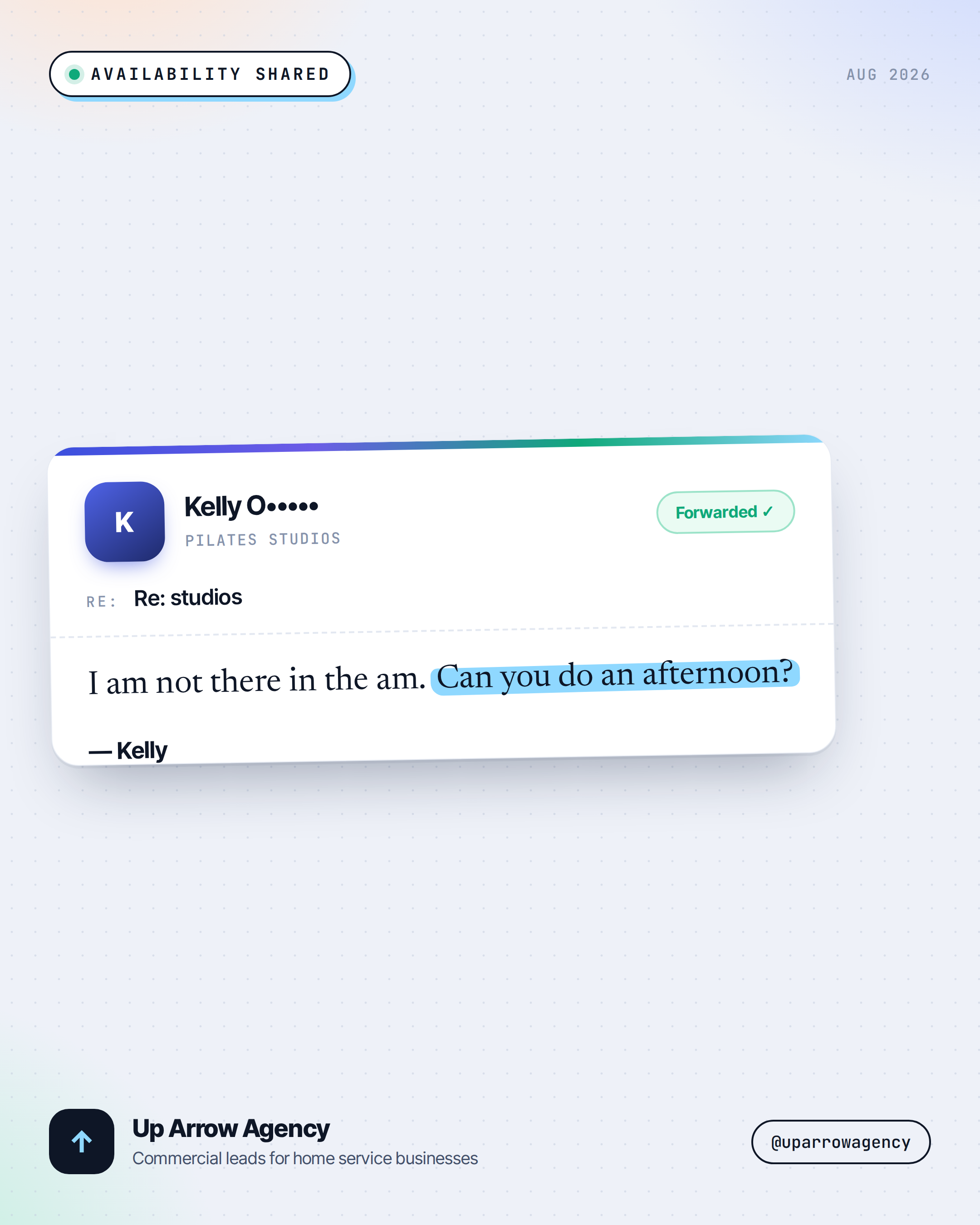
Thirteen of 69 replies asked for pricing. That's the second-biggest category, and handled the wrong way, it's where most of the value in this channel gets thrown away.
A pricing question this early isn't a sign someone only cares about cost. It's the easiest, lowest-effort question available to someone who doesn't have enough information yet to ask anything smarter. A facilities manager at a multi-site office portfolio, for example, who gets a cold email about carpet cleaning and writes back "what's your pricing" hasn't decided you're a commodity. They've decided you're worth a few seconds of their time to learn more. What they don't have yet is a reason to trust the outcome will be good, or a sense of what it would take off their plate.
Firing back a number answers the question they asked instead of the one they're actually sitting with: can I trust this vendor, and will this become a problem I now own. Quoting blind also means pricing a building you've never seen, which gets padded until it's uncompetitive or shaved until it's unprofitable. Either way, the relationship gets reduced to a number before there's any reason to pick you over it. Facility management research backs this up directly — FacilitiesNet has reported that "basing the decision on lowest cost will cost more," and recommends weighting vendor qualifications and quality alongside price rather than defaulting to the lowest bid.
The better move, every time, is to answer a pricing question with an offer to come look at the space — a free walkthrough. It costs the facilities manager nothing, it takes the guesswork out of the number for both sides, and it's the first real interaction where trust actually gets built.
The play that converts: reply, walkthrough, trust, contract
The sequence behind every one of the published results above runs the same four steps, in this order:
- Reply comes in. Whether it's forwarded to a decision-maker, a pricing question, or plain interest, the email did its job.
- Walkthrough gets booked. Not a quote sent — a time on the calendar to see the building, talk through what's actually needed, and let the facilities manager meet the people who'd do the work.
- Trust gets built on site. This is where you find what a blind quote would have missed — the stairwell carpet that's the real problem, the schedule constraint that matters more than price, the vendor they just fired and why. It's also where the risk comes off their plate: a specific plan, a specific crew, a specific guarantee.
- The offer gets presented and the contract gets signed. Priced for the real job, not a guess, and backed by a conversation the facilities manager was part of.
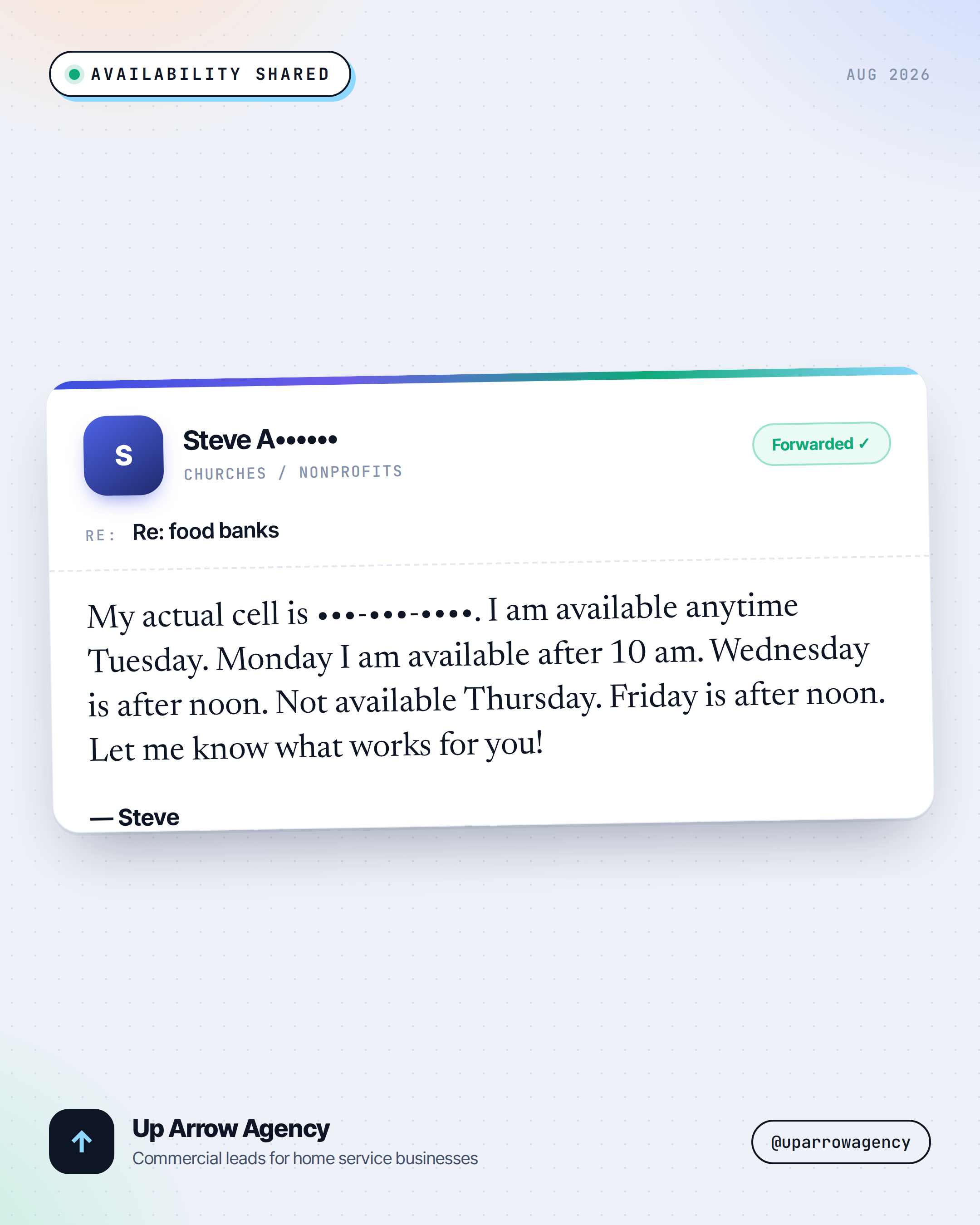
Only one of the 69 replies in our sample asked for a walkthrough outright. That's not a weak spot in the data — it's a reminder that almost nobody opens a cold-email relationship by asking to meet in person. They open with the easy question: price, more detail, "sounds interesting." The walkthrough is something the vendor offers in response to that opening, not something buyers request by name, and it's the single highest-leverage move in the whole sequence. The cleaning industry's own trade association treats it as non-negotiable: ISSA's guidance on winning new accounts states that "there is nothing more crucial to the acquisition of new business than a successful walkthrough."
Where lead generation agencies actually fail cleaning companies
When this channel doesn't work for a cleaning company, it's rarely because cold email "doesn't work for services." It's because of what happens after the reply:
- Quoting blind instead of booking a site visit. The biggest value-killer. It turns a relationship sale into a price comparison before the vendor has said a word about why they're different.
- Treating a reply as the finish line. Agencies that report "replies" or "leads" as the success metric, with no visibility into whether a walkthrough got booked or a contract got signed, are optimizing for the wrong number.
- Generic copy that ignores the vertical. A janitorial contract, a pressure-washing job, and a one-time carpet-cleaning job are different sales with different buyers and different urgency. Copy written for "cleaning companies" in general underperforms copy written for the specific service and building type.
- No follow-up cadence. A facilities manager who doesn't answer the first email isn't a no. Property and facilities teams are busy, and every published result above came from a sequence, not a single send.
Our cold email playbook for cleaning companies goes deeper into how the sequence and targeting should be built so replies like these show up in the first place.
Do lead generation agencies work for cleaning companies? The honest answer
Yes, with one condition: the agency has to be generating real conversations with people who control a budget, and the company on the other end has to treat every one of those conversations — including a flat "what's your pricing" — as an invitation into a relationship, not a request for a number.
That's consistent with how this channel performs for us. Carpet and upholstery, pressure washing, and commercial cleaning accounts booked through cold email have closed into five- and six-figure contracts, and almost all of them started with a reply that looked, on paper, like "just send pricing." For a fuller breakdown of how this fits into a complete lead gen approach for the industry, see our commercial cleaning lead generation guide.
Frequently asked questions
How long does it take to see results from a lead generation agency for a cleaning company?
What's the difference between a cold email reply and an actual signed cleaning contract?
Should a cleaning company quote a price in the first reply to a cold email lead?
Do lead generation agencies work for small or newer cleaning companies, or only established ones?
Want these replies landing in your inbox?
We run the whole cold-email engine for commercial cleaning & pressure washing companies — targeting, inboxes, and booking — so you get decision-maker conversations without ads or cold calling.
Book a 30-minute callMore from the guides: How to get commercial cleaning contracts · Lead generation: DIY vs. done-for-you · All guides