
Key takeaways
- For most cleaning companies under a few million in revenue, an agency gets you to booked walkthroughs sooner and with less risk than a first SDR hire.
- An in-house SDR is a good fit once you have a proven offer, a repeatable pitch, and a manager who will coach them weekly.
- Bridge Group's 2025 survey of 351 B2B companies puts SDR ramp at about 3 months and median annual attrition at 40%. Both matter more than the salary.
- Cold email has deliverability rules (SPF, DKIM, DMARC, spam-rate limits) that a lone new hire usually has to learn the hard way.
- Whichever route you pick, the goal is the same: turn a reply into a walkthrough, because that is where trust and the contract get built.
If you run a commercial cleaning company and need more conversations with property and facilities managers, the lead gen agency vs in-house SDR for cleaning companies question usually comes down to this: an agency is the better first move when you don't yet have a proven outbound process, and an in-house SDR is the better move once you do. The agency gets you into the market in weeks. The SDR gets you a dedicated person, but only after months of ramp and management, and only if they stay.
The comparison most owners make (and why it misleads)
Owners usually line up a salary against a monthly retainer and pick the smaller number. That treats lead generation like buying supplies. It isn't. What you are buying is booked walkthroughs: a decision-maker agreeing to meet you at their building. Everything else is a means to that.
So the useful questions are: how long until the first walkthrough lands on my calendar, how likely is it that this works at all, and how much of my own time does it eat? Cost matters, but it comes after those.
What an in-house SDR actually takes
Ramp time and turnover
The Bridge Group's 2025 SDR Models & Metrics Report, a survey of 351 B2B companies, found an average ramp of about three months and an average tenure of 1.9 years. Median annual attrition was 40%. That is a software-heavy sample, so treat it as directional for cleaning, but the pattern holds for small companies too: you pay for months before the hire is productive, and a meaningful share leave before they pay it back.
The same report puts median on-target earnings at $80K. That is pay only. It leaves out the email tooling, domains, mailboxes, data, and the hours you spend training and checking their work.
The part nobody budgets: management
An SDR who has never sold janitorial or carpet services needs a script, a target list, and feedback. If you are the owner and also the estimator and the person who handles complaints, that coaching does not happen consistently. Most failed first hires I see fail here, not on talent.
Deliverability is its own job
Cold email lives or dies on inbox placement. Google's email sender guidelines call for SPF, DKIM and DMARC authentication, one-click unsubscribe on marketing mail, and a spam-complaint rate kept low (they point to staying under 0.30%, with a stricter 0.10% target for monitoring). Yahoo's Sender Hub sets similar expectations. The formal bulk-sender rules start at 5,000 messages a day to Gmail, which a small program won't hit, but the spam-rate logic still governs whether your messages reach anyone. A new SDR learning this on your main domain can burn it.
What an agency changes
A done-for-you cold email agency already has the infrastructure, the list-building process, and the copy that has been tested against real replies. You skip the ramp. You also skip the learning curve on who to target and what to say, because that was paid for on other accounts.
It is not magic, and the track record should be specific. Published examples from our work include 48 commercial leads in 6 weeks, a client going from 4 to 27 commercial leads in 30 days, and a $38K/year recurring cleaning contract from a single campaign. Results vary by market and offer, and anyone who promises a fixed number before seeing your service area is guessing. If you want the mechanics behind these campaigns, our guide to cold email for cleaning companies walks through them.
What the replies look like
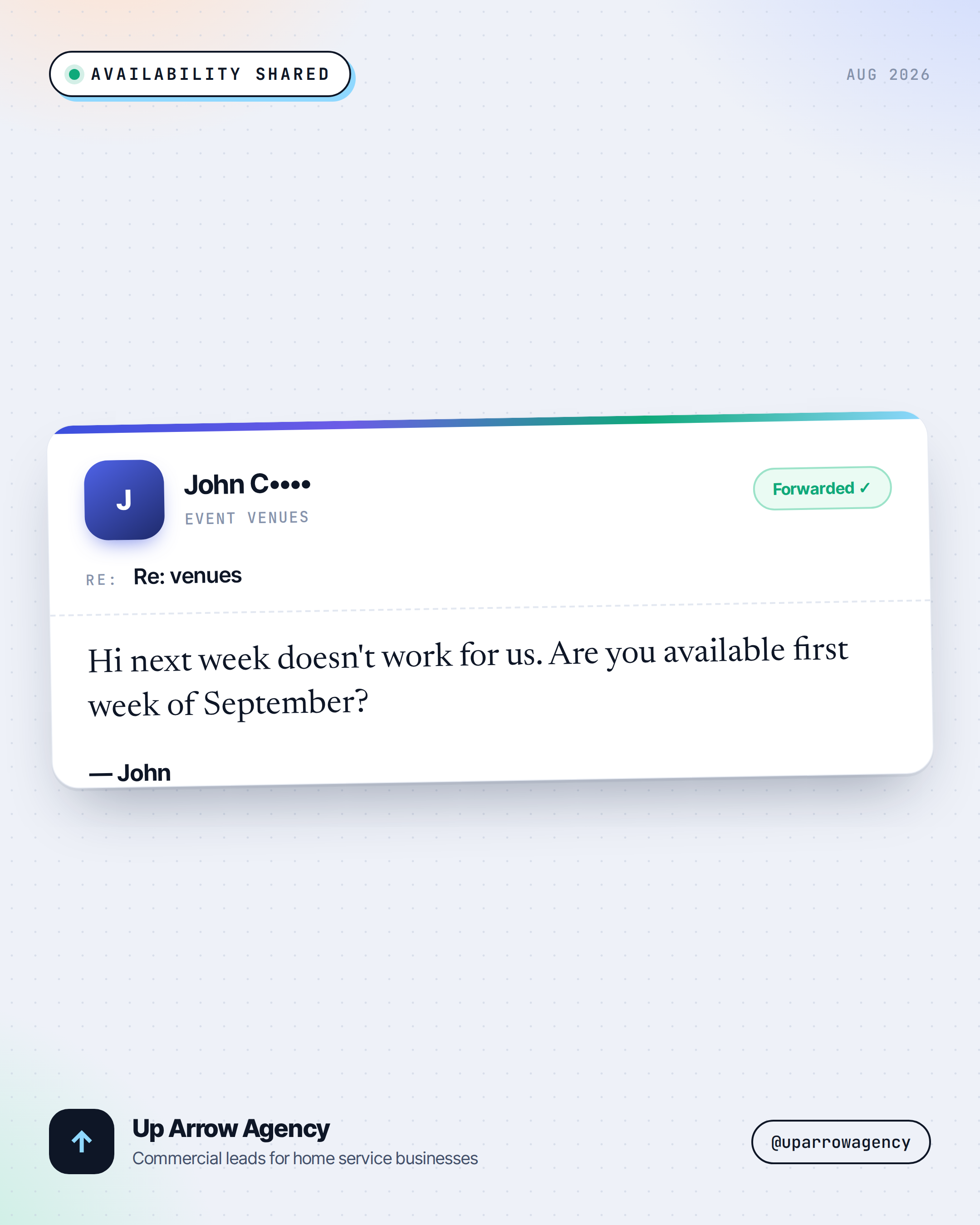
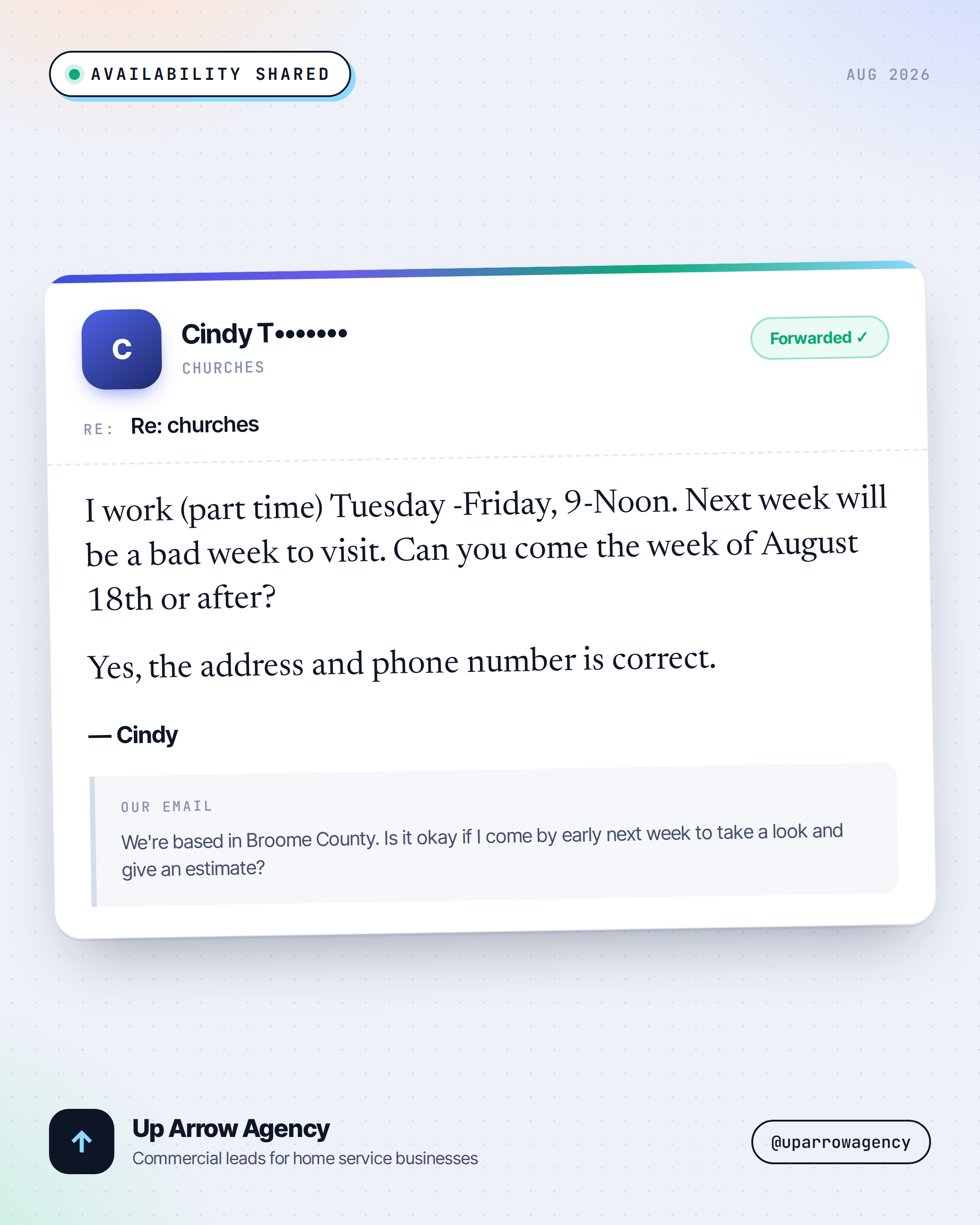
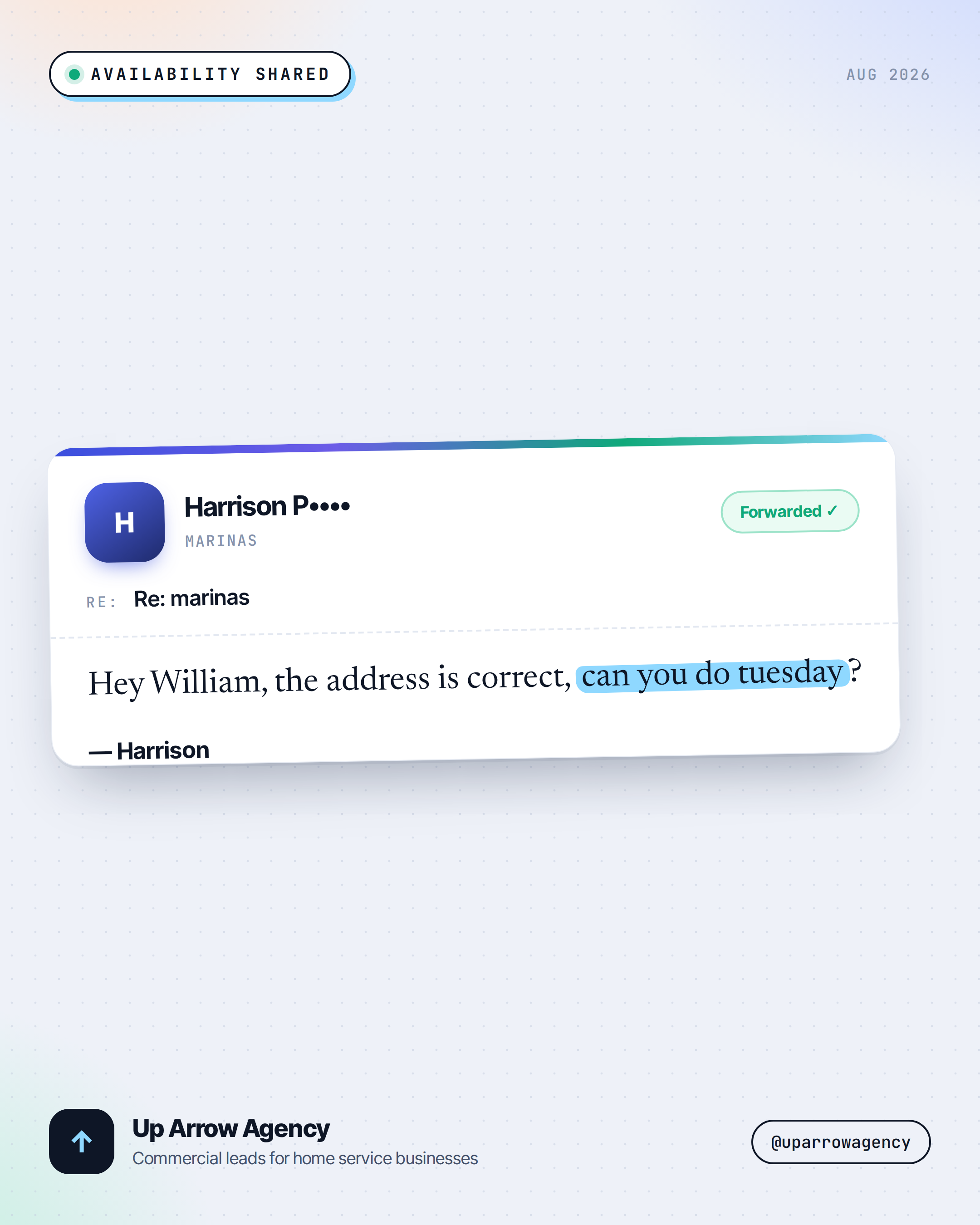
Across 2,271 genuine inbound replies to our clients' campaigns between April and October 2026, the largest groups were replies forwarded to the right decision-maker (1,156) and replies asking about pricing (1,001). Another 475 offered a call, and 282 asked for a walkthrough outright.
Notice what a pricing question is. It is an opening, not a verdict. The person is interested enough to ask and doesn't yet have enough context to see why your company is worth more than the next quote. Whoever handles replies, agency or SDR, should be steering that person toward a walkthrough, not firing back a number. A number sent blind gets compared to every other number. A walkthrough is where you see the building, ask what has gone wrong with the last vendor, and show you can take the problem off their plate.
Agency vs in-house SDR: side by side
| Factor | Lead gen agency | In-house SDR |
|---|---|---|
| Time to first outreach | Weeks, infrastructure already built | Hiring plus roughly three months of ramp (Bridge Group average) |
| Retention risk | Contract-based, you can switch providers | Median 40% annual attrition in the Bridge Group data |
| Management load on you | Light: approve offer, take walkthroughs | Heavy: coaching, call reviews, list direction |
| Deliverability know-how | Usually built in | Learned on your domain |
| Knowledge of your business | Learned fast, but outside your walls | Deeper over time, if they stay |
| Fixed cost | Often performance-based | Salary, tools, data whether or not meetings book |
When an in-house SDR is the right call
Hire one when the offer is proven and you can describe exactly who you target, what the first email says, and how a reply becomes a walkthrough. At that point you are scaling something that already works, and owning the person and the data makes sense. It also fits if you have a sales manager with time to coach. Some companies do both: an agency to find what works, then an SDR to take over a channel that has been validated.
When an agency is the right call
Pick the agency if you are the owner doing the selling, if you have no outbound track record, or if you can't afford a hire that might not stick. It also fits when you want to test a market, say pressure washing or janitorial work in a new area, without committing a salary to it. Performance-based terms take even more of the risk off you.
Either way, what wins the contract is what happens after the reply. Show up, walk the site, understand what they need, and make yes easy. Our guides on commercial cleaning lead generation and how to get commercial cleaning contracts cover that second half in detail.
A quick way to decide
- No proven outbound yet, owner is the closer: start with an agency.
- Proven offer, a manager with coaching time, steady volume: consider an SDR.
- Unsure: run an agency for a quarter, document what works, then decide if you want to bring it in-house.
Frequently asked questions
Is a lead gen agency cheaper than an in-house SDR for a cleaning company?
How long does it take an in-house SDR to become productive?
Can I use an agency first and hire an SDR later?
What should happen when a prospect replies asking about price?
Want these replies landing in your inbox?
We run the whole cold-email engine for commercial cleaning & pressure washing companies — targeting, inboxes, and booking — so you get decision-maker conversations without ads or cold calling.
Book a 30-minute callMore from the guides: How to get commercial cleaning contracts · Lead generation: DIY vs. done-for-you · All guides