
Key takeaways
- The best commercial cleaning cold email templates ask for one thing: a short walkthrough of the building. They do not ask for a contract or a quote.
- Five touches spread over about three weeks works better than one email. Each touch should add something new, not just 'bump' the last one.
- A pricing question is a buying signal. Answer it by offering the walkthrough, because a number sent blind turns you into a commodity.
- Keep emails short, specific to the building type, and written to one person. Deliverability and compliance basics decide whether anyone sees them.
- Every template below is a starting point. Swap in your service line, your real proof, and the way you actually talk.
The commercial cleaning cold email templates that work share one trait: they ask a property or facilities manager for a 15-minute walkthrough of the space, not for a decision. Below is a five-touch sequence you can copy, with the reasoning behind each email so you can rewrite it in your own voice.
We run this kind of outreach for commercial cleaning, janitorial, pressure washing and carpet companies, and the structure has held up across those service lines. It is the same logic we lay out in our guide to cold email for cleaning companies.
Why the walkthrough is the call to action
Most cleaning companies write cold emails that end with 'let me know if you'd like a quote.' That invites a price comparison before the buyer knows anything about you. A walkthrough does the opposite. You stand in the building, see the floors, the restrooms, the after-hours access, and you learn what the manager is actually worried about. They get to meet you and decide whether they trust you with their keys.
That matters because a facilities manager is buying reliability, and reliability is hard to judge from an email. Facility management, as IFMA describes it, is about keeping a building running smoothly, safely and efficiently. Your job in the sequence is to show you understand that and to make the next step easy: free, short, on their schedule.
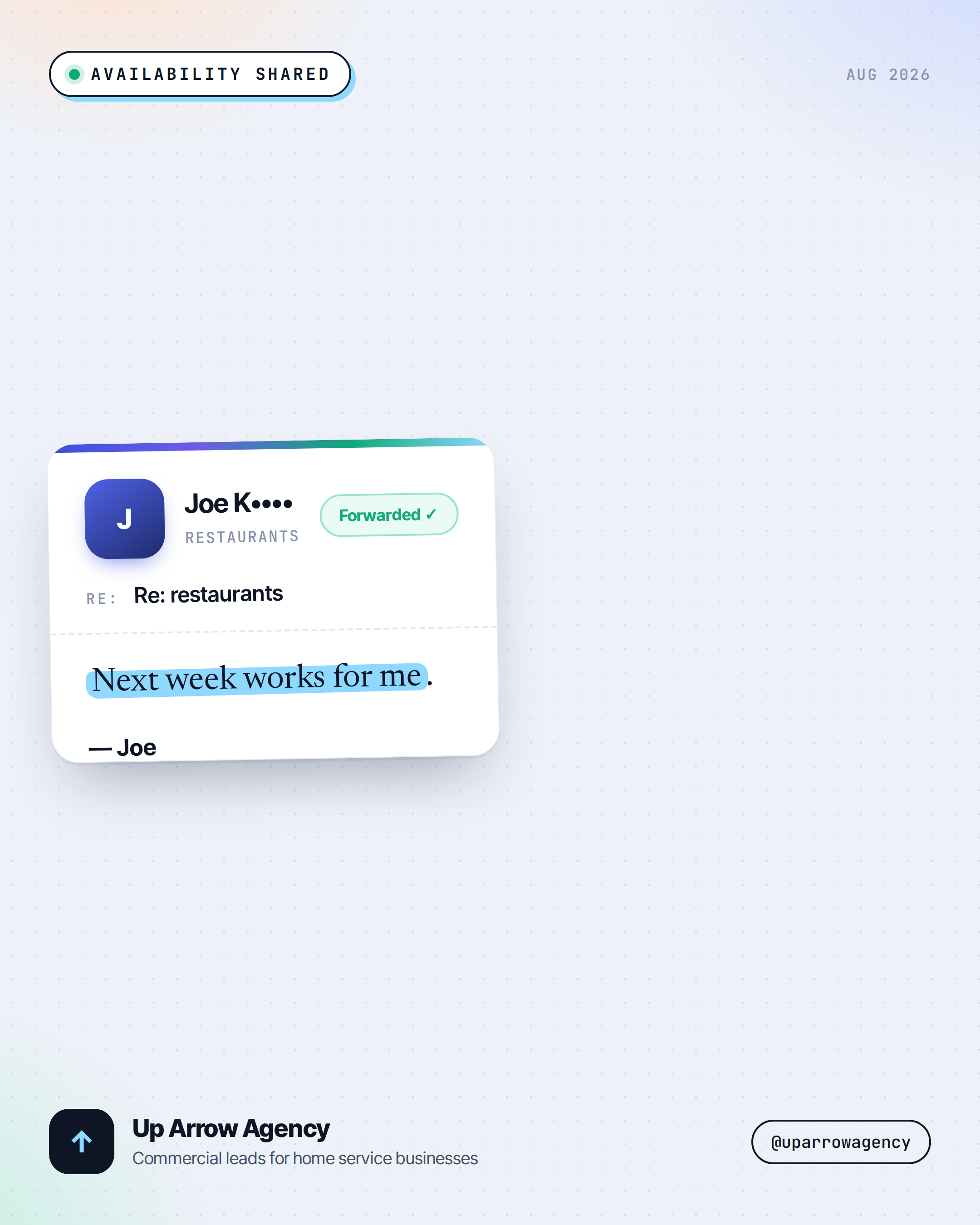
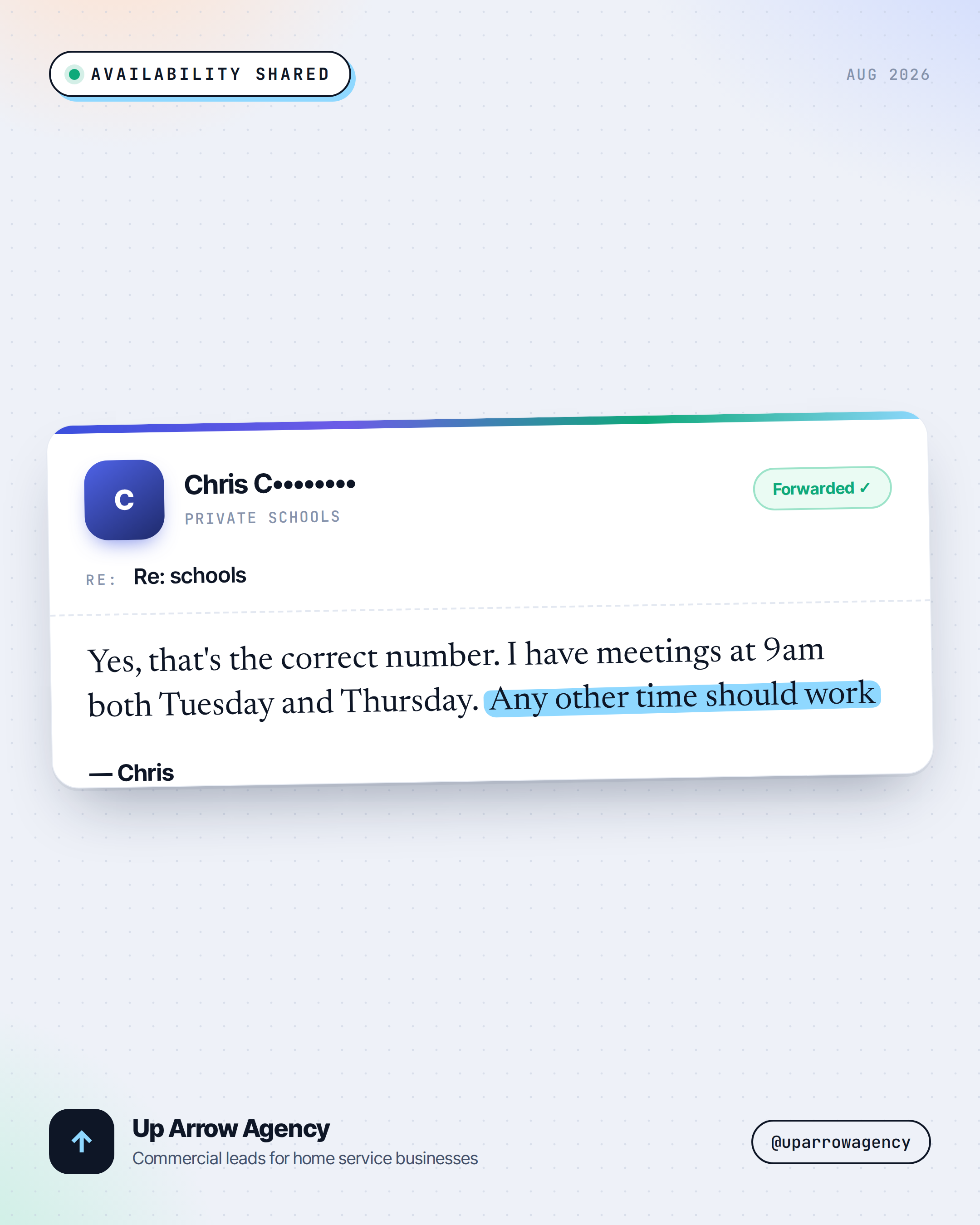
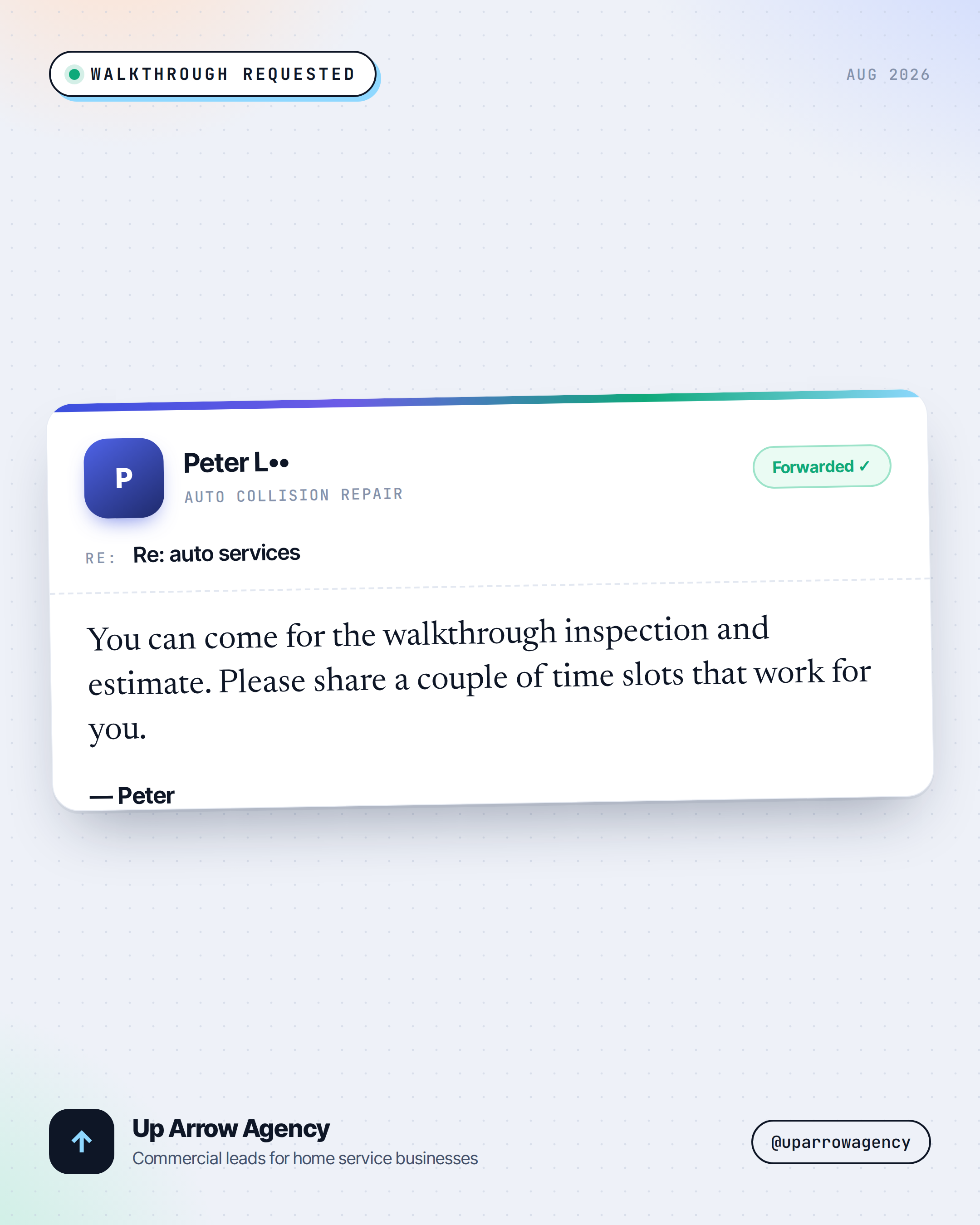
One data point from our own inbox, mentioned only for context: across 2,271 genuine replies to commercial cleaning campaigns between April and October 2026, 282 were people asking directly for a walkthrough or site visit, and many more asked about pricing first. Those pricing questions are the same conversation arriving by a different door. We treat them as an invitation to book the walkthrough.
The 5-touch sequence at a glance
- Touch 1 (day 1): a short intro tied to their building type, with a walkthrough offer.
- Touch 2 (day 4): a different angle, usually a specific problem you fix.
- Touch 3 (day 8): proof and risk reversal.
- Touch 4 (day 14): make saying yes smaller.
- Touch 5 (day 21): a polite close that leaves the door open.
These timings are our working recommendation, not an industry standard. Adjust them to your volume and how fast your team can actually get to a site.
Touch 1: the intro
Keep it under 90 words. Name the building type, say what you do, and ask for the walkthrough.
Subject: cleaning at [building type]
Hi [First Name],
I run a commercial cleaning company that works with [office buildings / medical offices / multi-tenant properties] in [area]. We handle [nightly janitorial / carpet care / floor care] and we're taking on a few new accounts this quarter.
Would you be open to a 15-minute walkthrough of the space? No charge. I'd rather see what you're dealing with before I say anything about scope or cost.
Worth a visit?
[Name]
Notice the last line of the body sets the walkthrough as the way you work, which quietly explains why you are not attaching a price sheet.
Touch 2: lead with a specific problem
Do not write 'just following up.' Say something new. Pick a problem that building type really has: missed restroom restocks, carpets that look tired in the lobby, a current vendor who stops answering.
Subject: re: cleaning at [building type]
[First Name], one more thought. The most common thing we hear from managers of [building type] is that the cleaning is fine for a few months and then quality slips and nobody picks up the phone.
When we start with a new building we walk it with the manager first, agree on what 'done' looks like, and put one person's number on it. If that's useful, I can come by this week or next.
Touch 3: proof and risk reversal
This is where a real result earns its place. Use something you can back up. If you have a published win, say so plainly. For reference, the results we have shared publicly include 48 commercial leads in 6 weeks and a $38K/year recurring cleaning contract from a single campaign. Those are our numbers as a lead-generation agency. Your proof is different: how long you have held accounts, a retention story, a before-and-after of a floor.
Subject: how we handle the first 30 days
[First Name], a lot of managers have been burned by a vendor who looked good on paper. So here's how we reduce that risk: [short, honest description of your onboarding, inspection routine, and what happens if you miss something].
I'm happy to walk you through it on site. Fifteen minutes, whenever suits you.
Touch 4: make yes smaller
By now the reader has seen three emails. Reduce the effort. Offer two specific windows and let them reply with one word.
Subject: Tuesday or Thursday?
[First Name], I'll be in [area] Tuesday morning and Thursday afternoon. Would either work for a quick look at the space? If someone else handles vendors, point me to them and I'll take it from there.
That last sentence matters. Many replies to cold email are forwards to the actual decision-maker. In our campaigns, forwards were the largest single response type, more than 1,100 of those 2,271 replies. Make forwarding effortless.
Touch 5: the polite close
Subject: closing the loop
[First Name], I'll stop here so I don't clutter your inbox. If cleaning is ever on your list, a walkthrough is free and there's no obligation. Either way, I hope the building is running well.
Do not make it guilt-flavored or sarcastic. A calm close gets replies months later.
What to do when the reply is 'how much?'
Someone will answer your first email with a price question. That is a good sign. They are interested and that is the easiest question to ask. Reply warmly, tell them honestly that cost depends on square footage, frequency, floor types and access, and offer the walkthrough so your number reflects their building. If you send a figure blind, you become one of three quotes on a spreadsheet. If you walk the space, you become the person who understood it.
For the full playbook on turning replies into signed accounts, see our guide on how to get commercial cleaning contracts.
The unglamorous part: deliverability and compliance
A perfect template does nothing if it lands in spam. The FTC's CAN-SPAM compliance guide requires accurate sender information, honest subject lines, a physical postal address and a working opt-out, and you remain responsible for email sent on your behalf. Mailbox providers go further for high-volume senders: Google's sender guidelines call for SPF, DKIM and DMARC authentication, one-click unsubscribe and a low spam-complaint rate. Small campaigns may sit under the bulk-sender threshold, but those habits are cheap and protect your domain.
Practical rules we follow: send from a separate domain, keep volume modest per inbox, plain text over heavy HTML, and honor every opt-out immediately.
How to adapt these templates
- Change the building type first. A dental office and a warehouse office have different worries.
- Use your own words. If a line sounds like a brochure, rewrite it the way you'd say it on a site visit.
- Only claim what's true. No invented client counts or savings.
- Write to one person. Property managers, office managers and operations managers each care about slightly different things.
If you want the broader system around these emails, from list building to booking, our overview of commercial cleaning lead generation covers it.
Frequently asked questions
How many emails should a commercial cleaning cold email sequence have?
What should the call to action be in a commercial cleaning cold email?
Should I include pricing in the first email?
Who should I send commercial cleaning cold emails to?
Want these replies landing in your inbox?
We run the whole cold-email engine for commercial cleaning & pressure washing companies — targeting, inboxes, and booking — so you get decision-maker conversations without ads or cold calling.
Book a 30-minute callMore from the guides: How to get commercial cleaning contracts · Lead generation: DIY vs. done-for-you · All guides