Key takeaways
- There are five realistic routes: an in-house SDR, DIY cold-email software, a generalist appointment-setting agency, shared-lead marketplaces, and a cleaning-specific done-for-you provider.
- Commercial cleaning contracts are won in person. Judge any option by how many walkthroughs it puts on your calendar, not by raw lead counts.
- Shared leads go to several vendors at once, so you start every conversation in a price comparison. Exclusive leads let you build value first.
- Software is cheap, but deliverability, copy, list building and reply handling are the real work. Add up that labor before you call DIY the budget option.
- Ask every provider the same five questions (listed below) before you sign anything.
The best commercial cleaning lead generation companies are not one ranked list. The right pick depends on how much of the work you want to own. If you have time and a sales person, build it in-house. If you want exclusive conversations with property and facilities managers and no sales hires, a done-for-you, performance-based provider fits. If you want volume of homeowner-style requests, shared-lead marketplaces fit, with the caveat that you will be competing on price.
This page is for owners of commercial cleaning, janitorial, carpet, and pressure washing companies who want contracts with offices, medical buildings, restaurants, and property portfolios. We run one of the options below, so we'll say where we fit and where we don't.
How to judge a lead source
Most comparisons stop at cost per lead. For commercial cleaning that is the wrong yardstick, because a recurring contract is decided by a facilities or property manager who wants to meet the vendor, see the building together, and trust the person who will manage it. Industry guidance on bidding reflects this. The BSCAI guide to evaluating janitorial bid opportunities describes buyers asking for site tours, written responses, in-person presentations, and references from similar facilities.
So we score each option on five things:
- Exclusivity: is the lead yours alone?
- Decision-maker access: do you reach the person who signs, or a gatekeeper?
- Path to a walkthrough: does the model move people toward an in-person visit?
- Your workload: what do you still have to build and run?
- Risk: what do you pay if nothing comes of it?
Comparison table
| Option | Exclusive? | Reaches decision-makers? | Your workload | Cost structure |
|---|---|---|---|---|
| In-house SDR | Yes | Depends on the hire | High: hiring, tools, coaching | Salary plus tools, paid whether or not meetings happen |
| DIY cold-email software | Yes | Depends on your list and copy | High: setup, lists, copy, replies | Monthly software fee plus your time |
| Generalist B2B agency | Usually | Generic targeting | Medium: you teach them the niche | Varies; often a retainer |
| Shared-lead marketplace | No | Mostly not; requests are inbound | Low to medium: respond fast, quote | Per-lead or per-job fees |
| Cleaning-specific done-for-you | Varies; ask | Built around facilities and property managers | Low: you take the walkthroughs | Varies; ask whether it is performance-based |
Option 1: Hire an in-house SDR
Best for: companies with a sales manager who can coach, and the patience for a slow ramp.
Pros: you own the process and the learning. Nobody knows your service quality better than your own people.
Cons: you pay before you know it works. For scale, the Bureau of Labor Statistics reports a May 2025 median pay of $76,460 for wholesale and manufacturing sales representatives. That is an adjacent occupation, not an SDR figure, and it leaves out benefits, tools, and management time. Add list data and sending infrastructure and it is a real fixed cost.
Option 2: DIY cold-email tools
Best for: an owner who likes tinkering and has more time than money.
Pros: the software is inexpensive. Smartlead's public pricing listed a $39 a month entry plan when we checked in November 2026. Instantly and similar tools are priced in the same tiered way.
Cons: the software is the smallest part of the job. You need authenticated sending domains and clean lists. Google's email sender guidelines require SPF, DKIM, and DMARC for bulk senders and ask senders to keep spam complaints under 0.30%. Then come copy that does not read as a template, replies that need an answer the same day, and a follow-up routine. Plenty of owners start this way and stop after a month.
Option 3: Generalist B2B appointment-setting agencies
Best for: companies selling to many industries, or those who want a team handling outreach.
Pros: they have process, staff, and tooling already running.
Cons: they often don't know what a facilities manager means by a scope of work, a night-shift crew, or a janitorial transition, so you may end up briefing them on your market. Ask who writes the copy, whether the booked meeting is a real site visit or a phone call, and what happens if you get none. Terms vary widely between agencies, so get them in writing.
Option 4: Shared-lead marketplaces
Best for: small-ticket work where speed of response matters most.
Pros: leads arrive without any outbound effort.
Cons: the lead is not yours alone. Angi's pro help center says each project request is matched with no more than five pros, and that lead fees vary by task, location, and demand. When several vendors get the same request, the first question the buyer asks is who is cheapest. You are in a price contest before you've shown any value, and a recurring office contract rarely starts that way.
Option 5: Cleaning-specific done-for-you providers
Best for: owners who want to spend their time on walkthroughs and proposals, not inboxes.
Pros: the targeting, copy, and reply handling are built around property managers, facilities managers, and office managers. Up Arrow Agency sits here. We run cold email for commercial cleaning, janitorial, pressure washing, and carpet companies, with no paid ads, referrals, or cold calling. The leads are exclusive to the client, the model is performance-based, and the goal is a booked walkthrough. Published results from our clients include 48 commercial leads in 6 weeks, $23K in commercial carpet-cleaning jobs from one campaign, and a $38K/year recurring cleaning contract from a single campaign.
Cons: it is not instant. Cold email builds over weeks, you still have to show up and do the walkthrough well, and outbound is a poor fit if your service quality is not ready for recurring contracts. A provider is only as good as the crew that follows up on its meetings. For the mechanics, see our guide to cold email for cleaning companies.
Why the walkthrough is the thing to buy
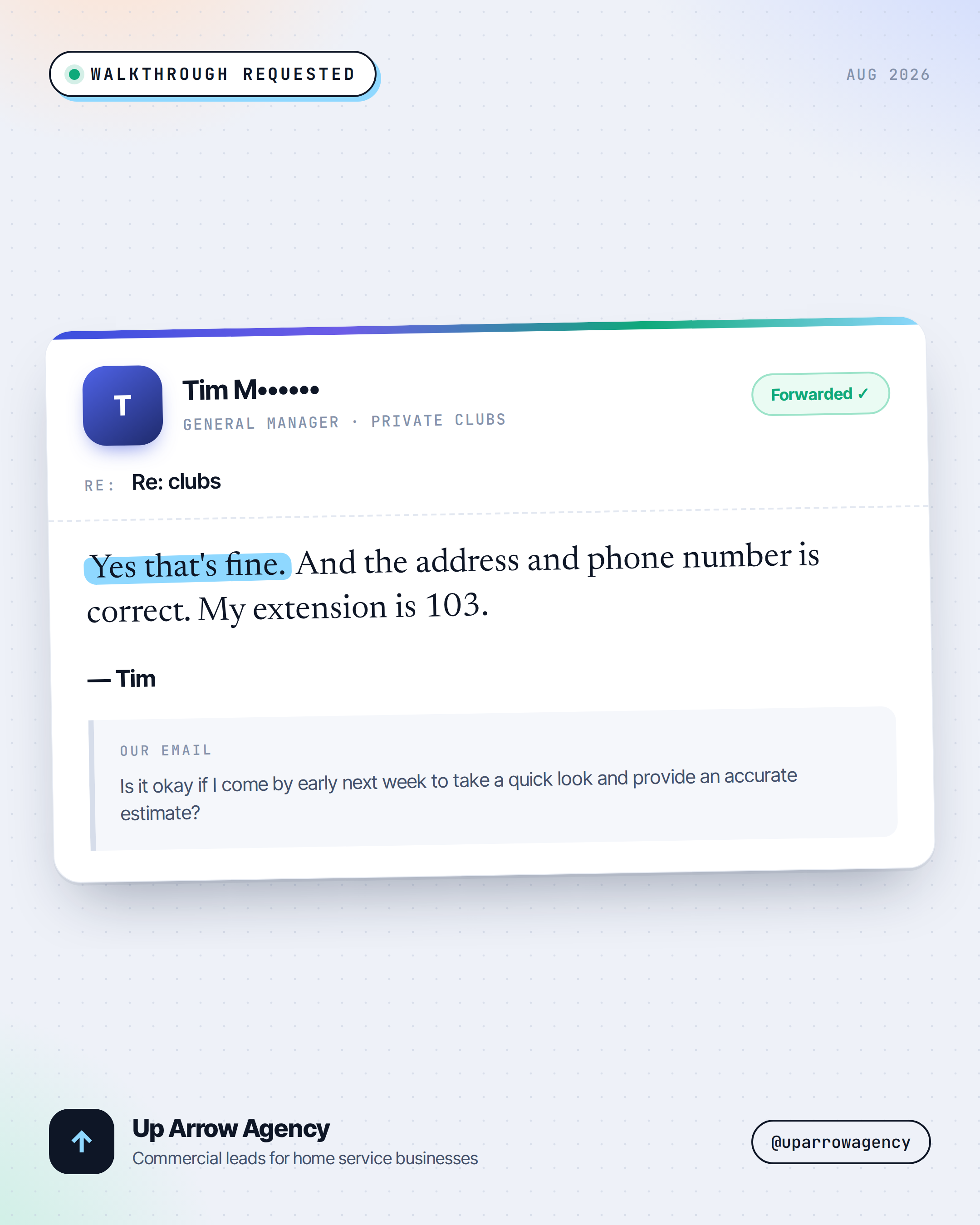
When a prospect replies to outbound, the first question is often about price. That is a normal first question and a good sign, not a verdict that price is all they care about. At that stage they have no context to ask anything else. The reply that converts offers a short, free walkthrough of the building, where you learn their situation, show you can deliver, and take the risk on your side. Quoting blind turns you into a number on a spreadsheet.
Whichever provider you choose, check that its model leads to this meeting. Across our commercial cleaning campaigns from April to November 2026, we logged 2,340 genuine replies. The biggest groups were forwards to the decision-maker (1,194) and questions about pricing (1,035), and 297 were direct requests for a walkthrough or site visit. Replies can fall into more than one group, but each of these is an invitation to start a relationship, and the provider should help you accept it quickly. The wider process is covered in our commercial cleaning lead generation guide.
Five questions to ask any provider
- Are the leads exclusive to me, or sold to others?
- Do you reach the person who signs the contract, and how do you know?
- Is the outcome a booked site visit, or just an email reply?
- What do I pay if there are no results?
- Who handles replies, and how quickly?
Which should you pick?
Pick an in-house SDR if you have a manager to coach one and a long runway. Pick DIY tools if you have the time and will treat it as a second job. Pick a shared-lead marketplace if your work is small-ticket and you can win on response speed. Pick a generalist agency if your market is broad. Pick a cleaning-specific, performance-based provider if you want exclusive conversations with building decision-makers and the walkthroughs to follow. If you're also building the rest of your pipeline, how to get commercial cleaning contracts covers what happens after the meeting.
If that last route sounds right, the next step is simple: book a walkthrough call with us, and we'll tell you honestly whether outbound fits your business.
Frequently asked questions
What are the best commercial cleaning lead generation companies?
Are shared leads worth it for commercial cleaning?
Is DIY cold email cheaper than hiring an agency?
How long does cold email take to produce commercial cleaning leads?
Want these replies landing in your inbox?
We run the whole cold-email engine for commercial cleaning & pressure washing companies — targeting, inboxes, and booking — so you get decision-maker conversations without ads or cold calling.
Book a 30-minute callMore from the guides: How to get commercial cleaning contracts · Lead generation: DIY vs. done-for-you · All guides